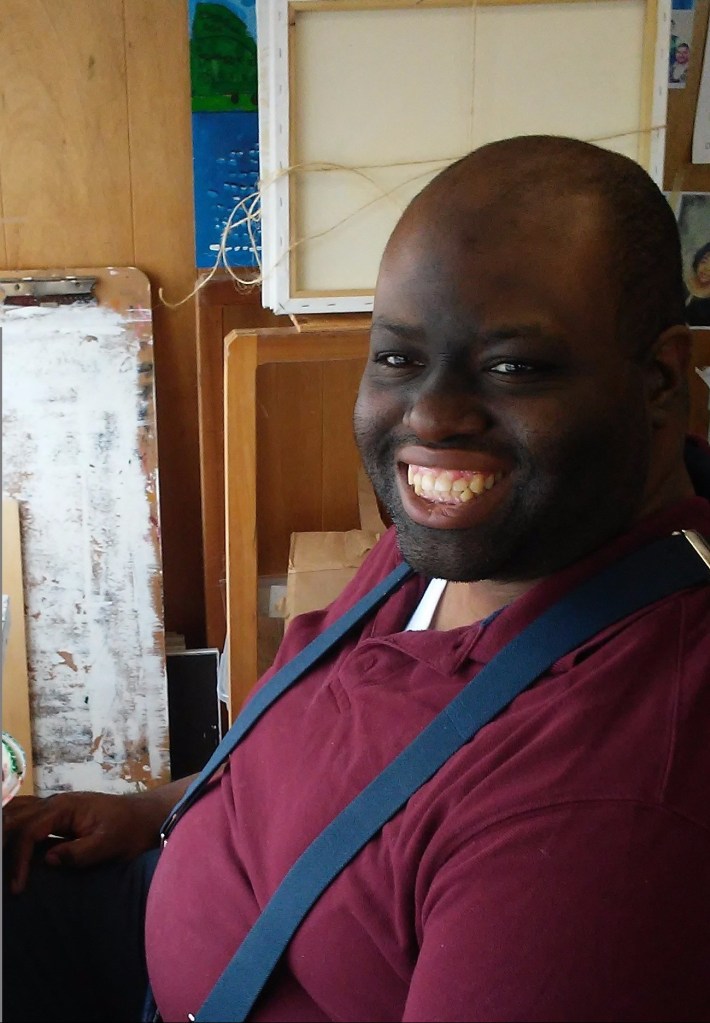
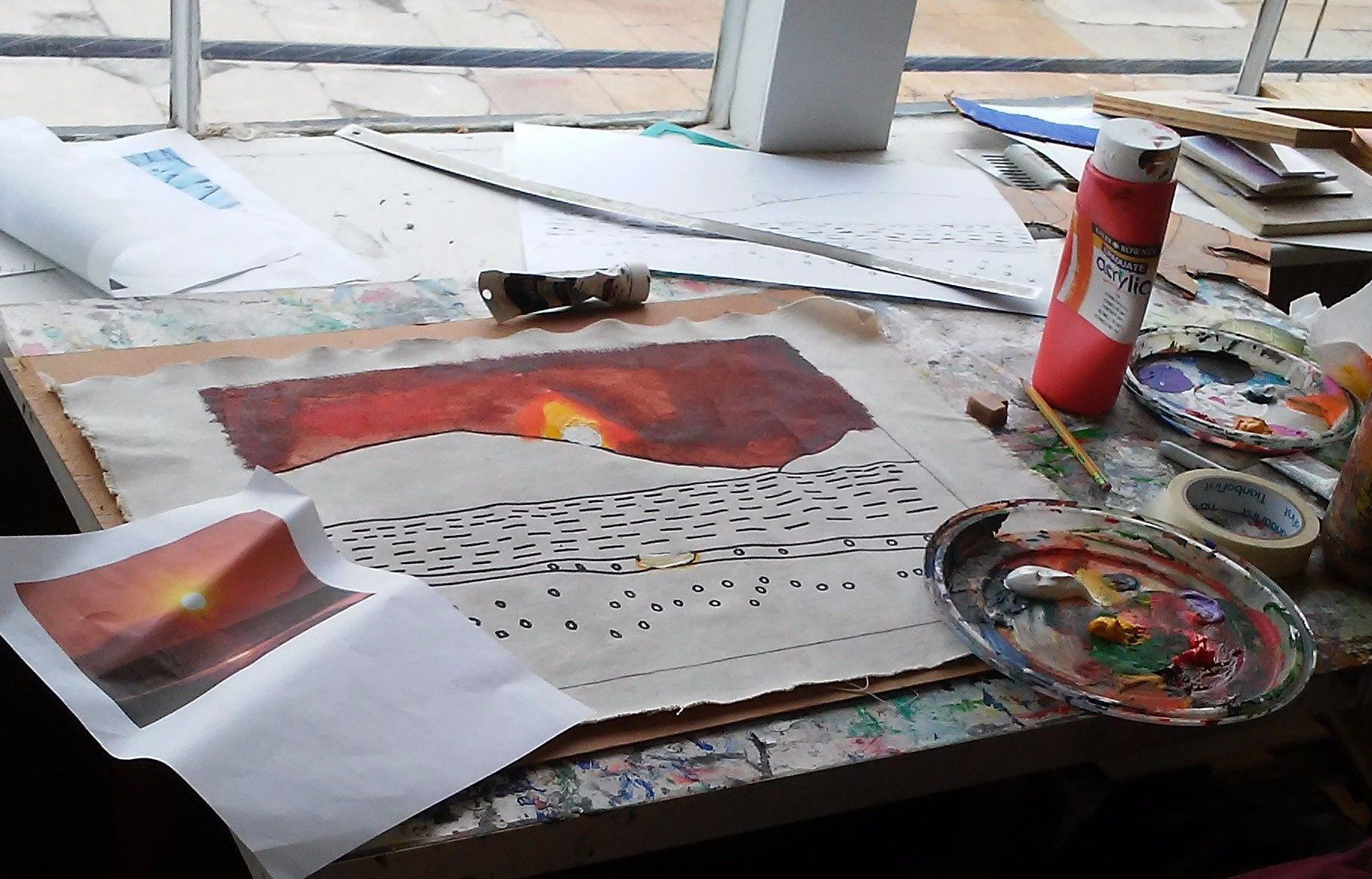
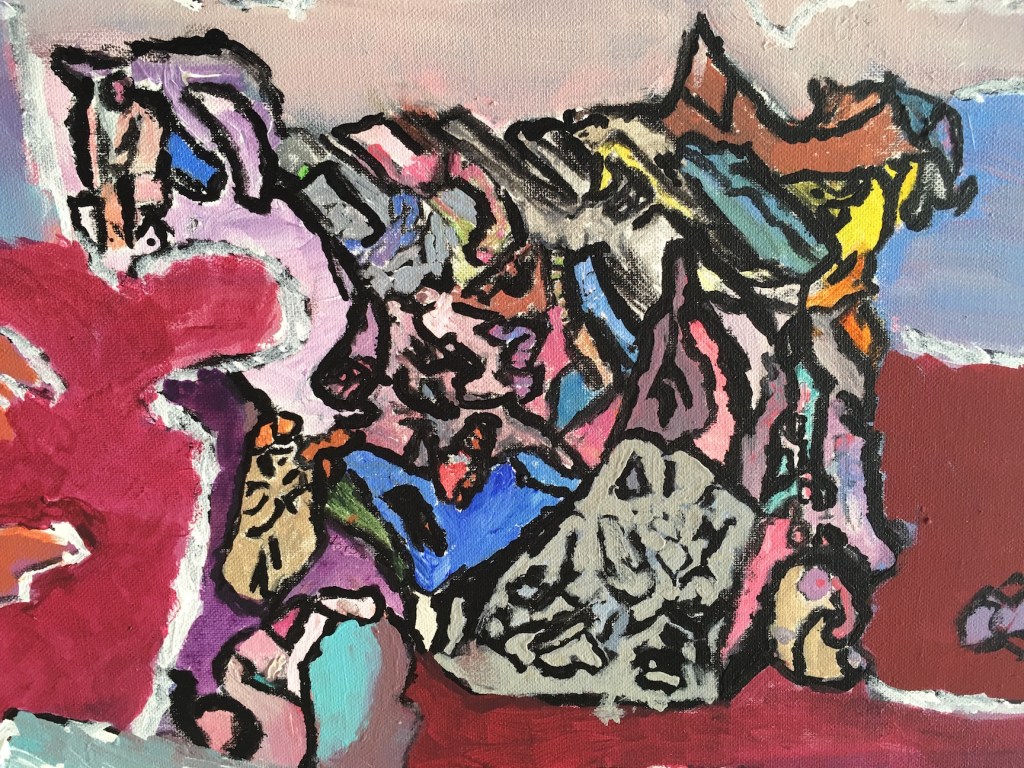
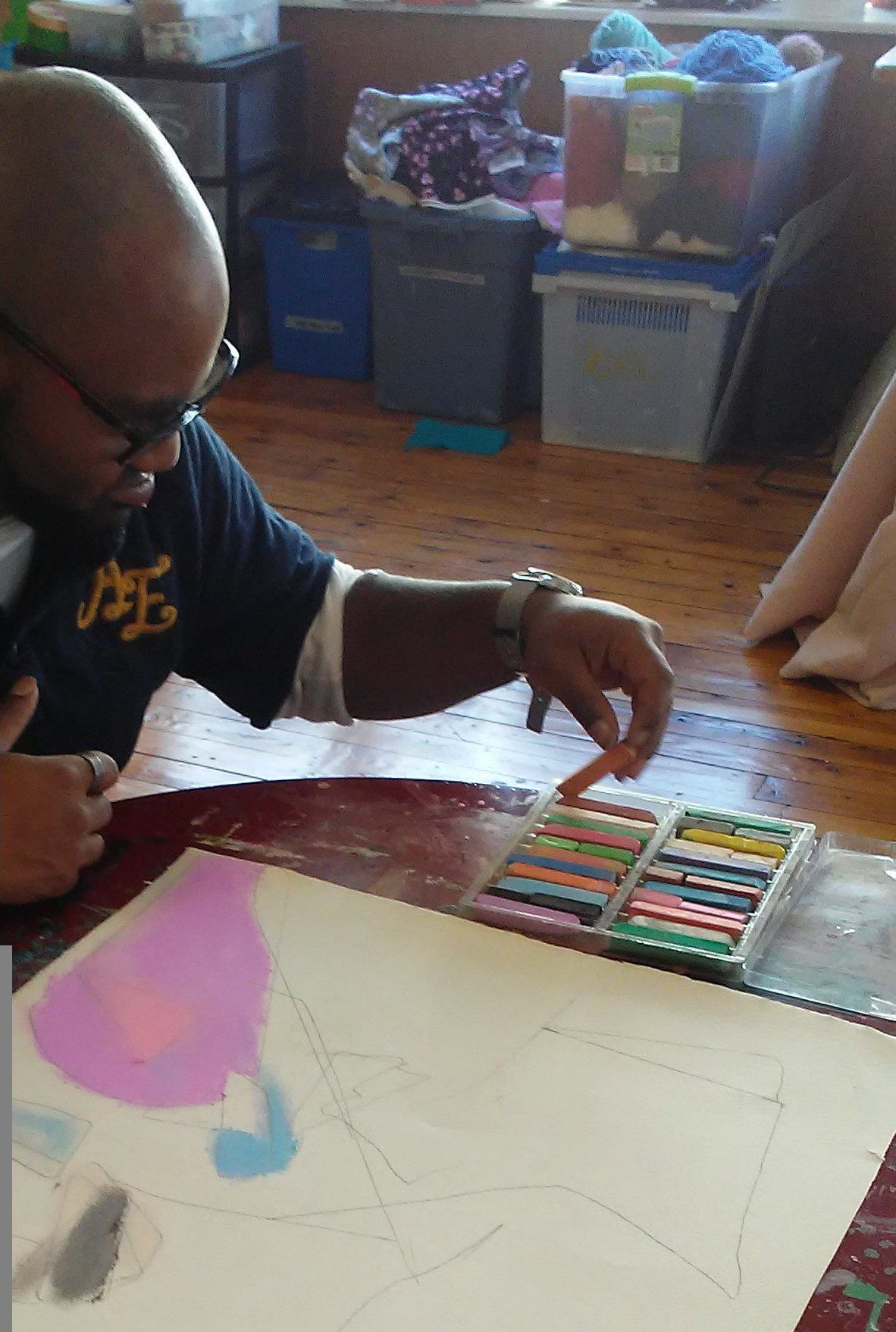
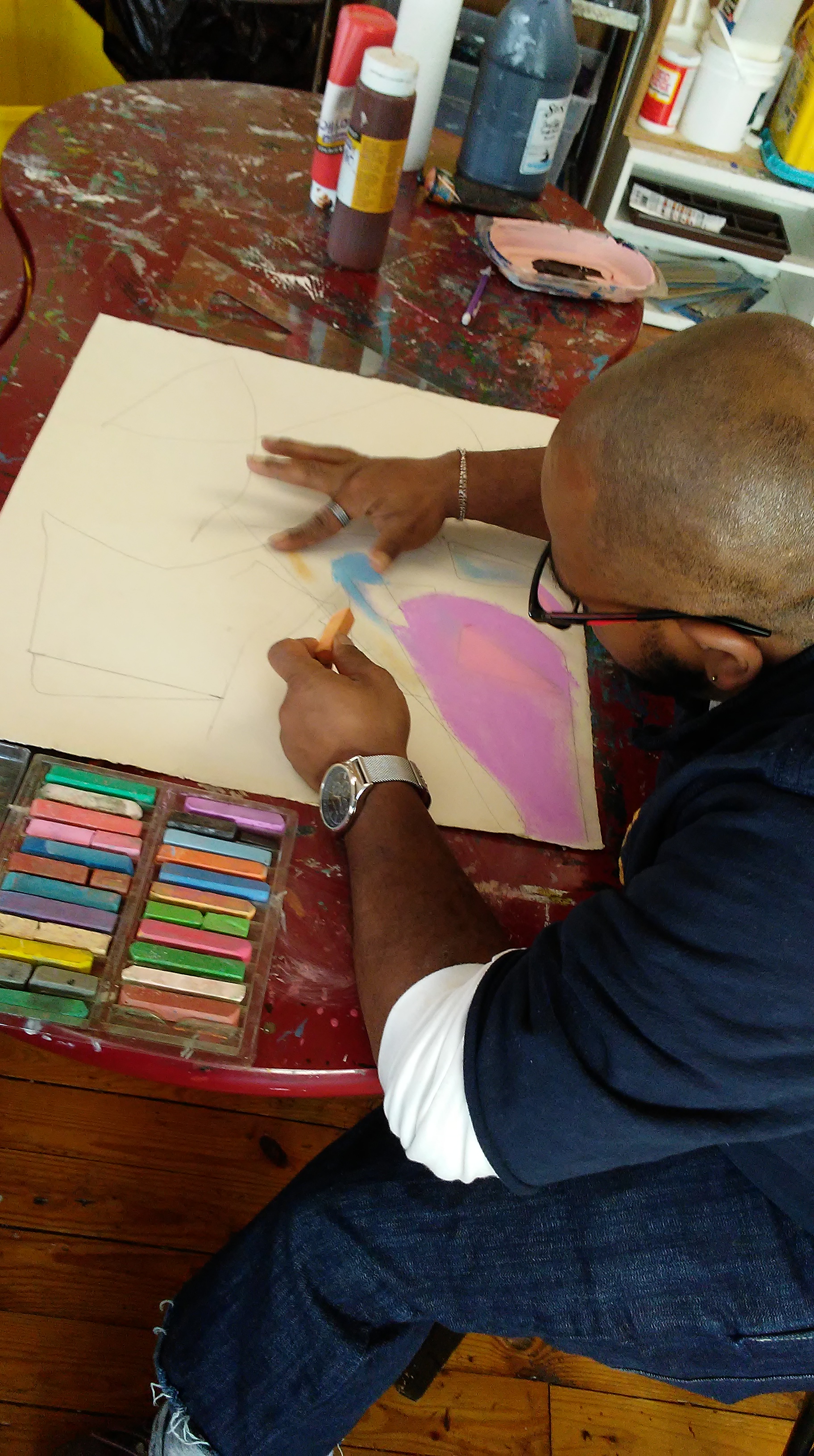
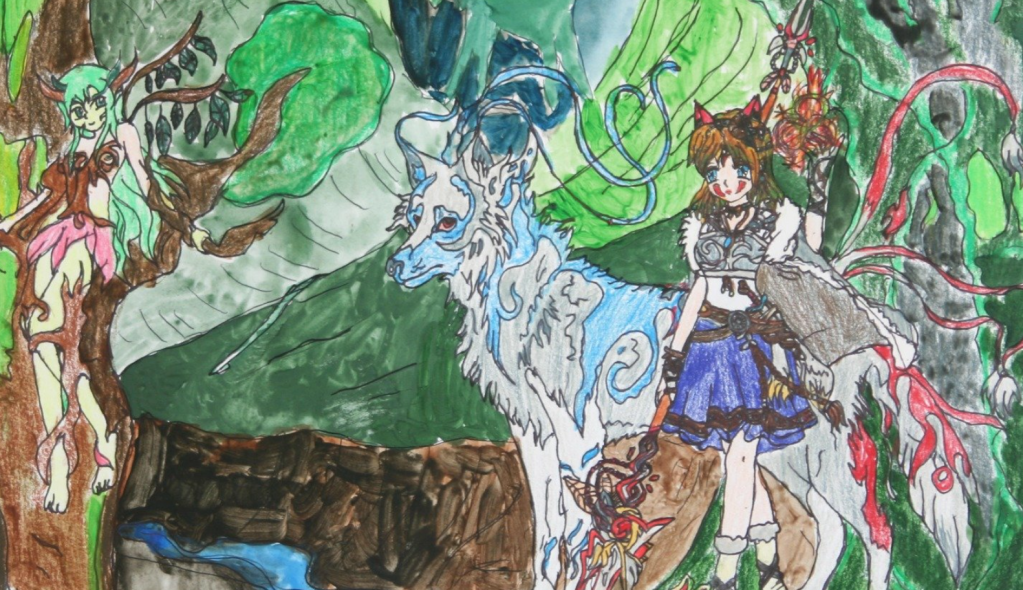
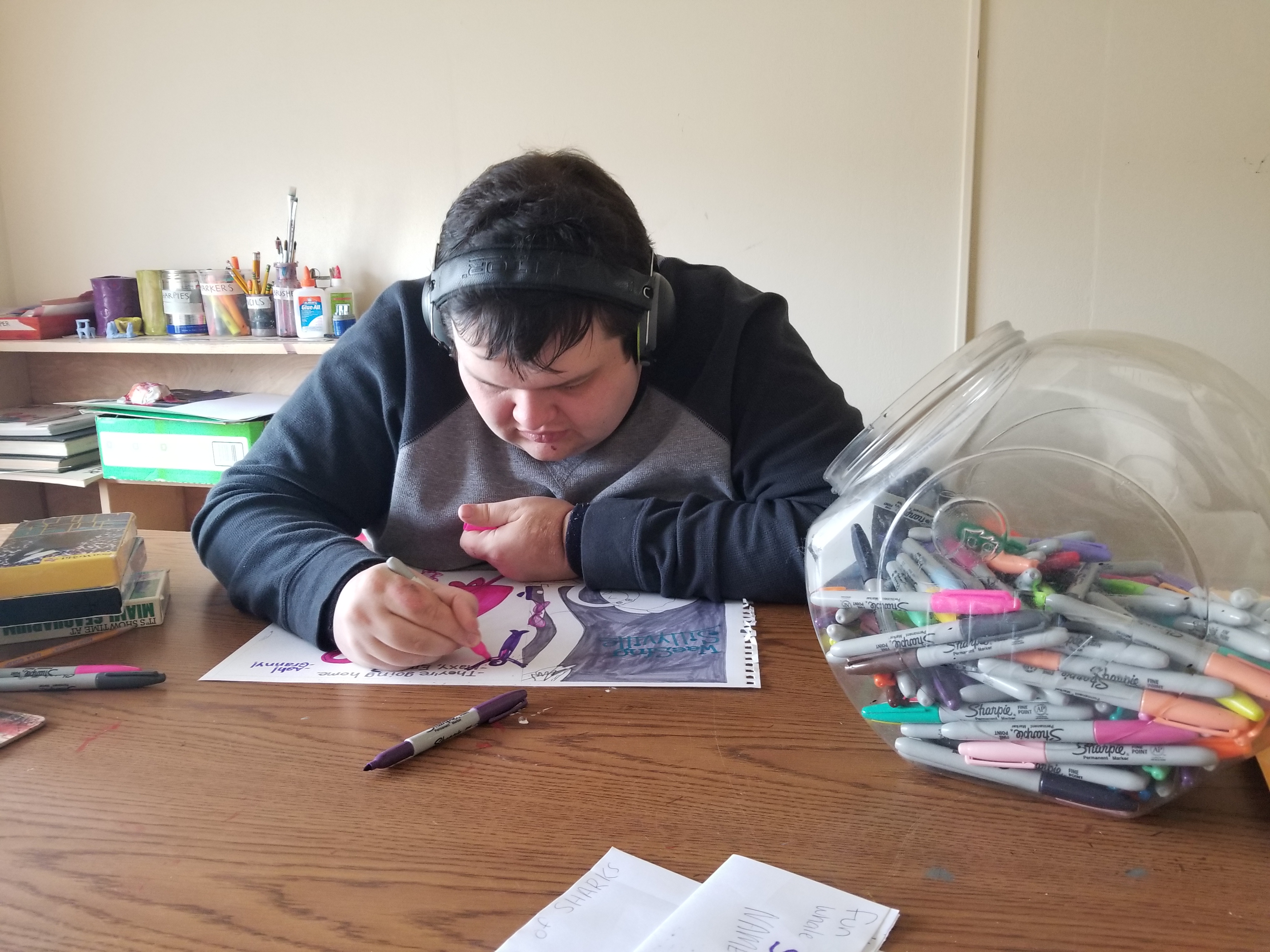
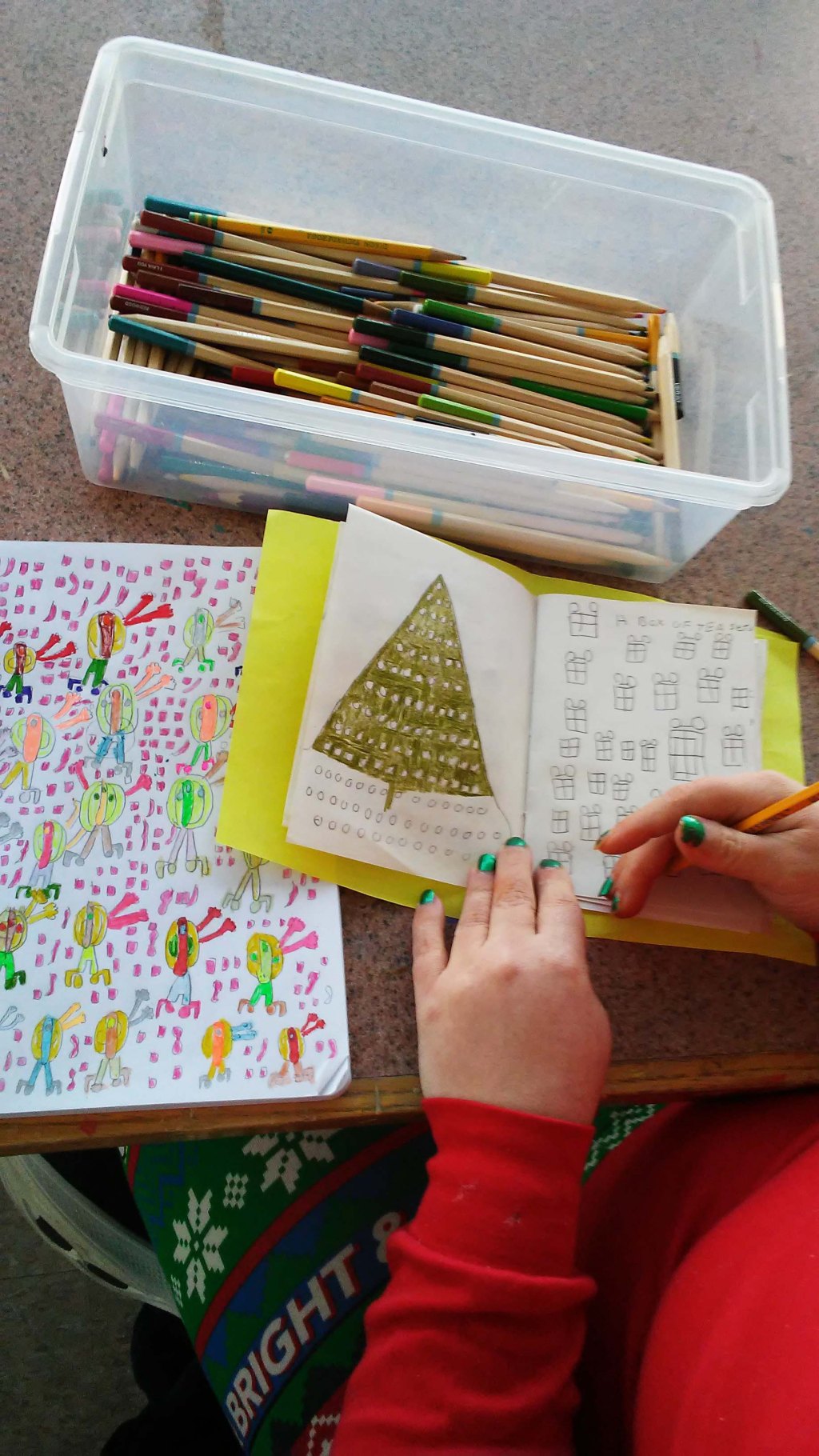
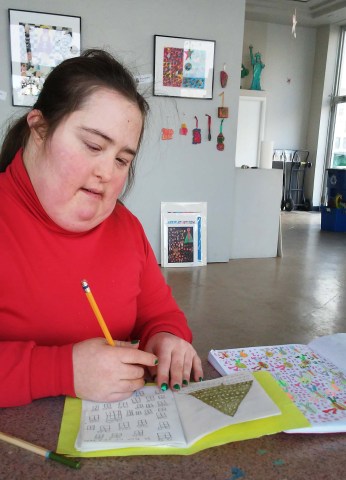
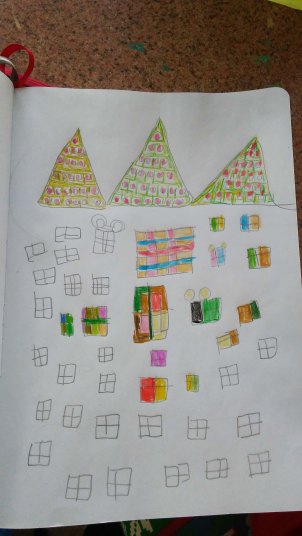
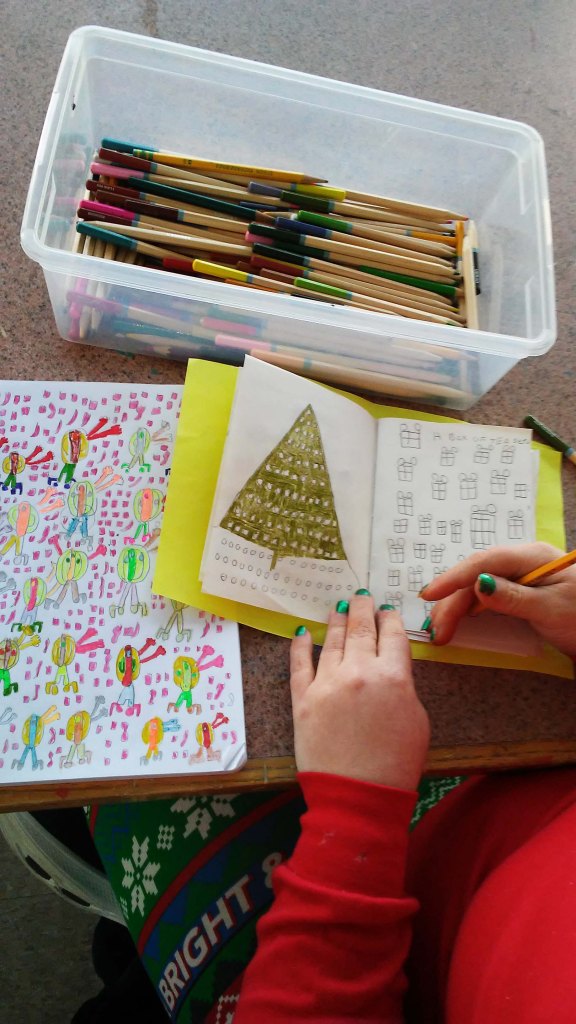
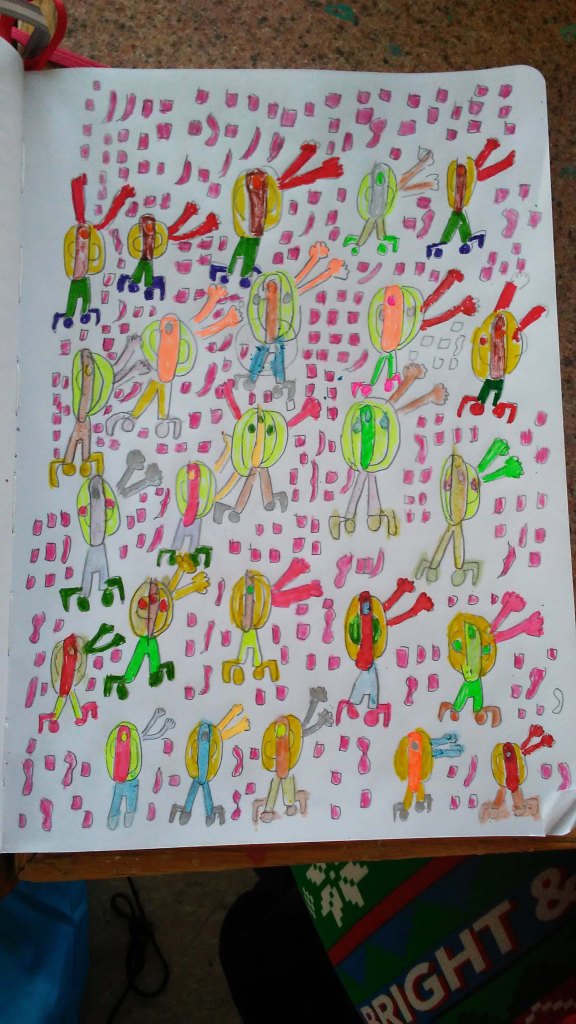
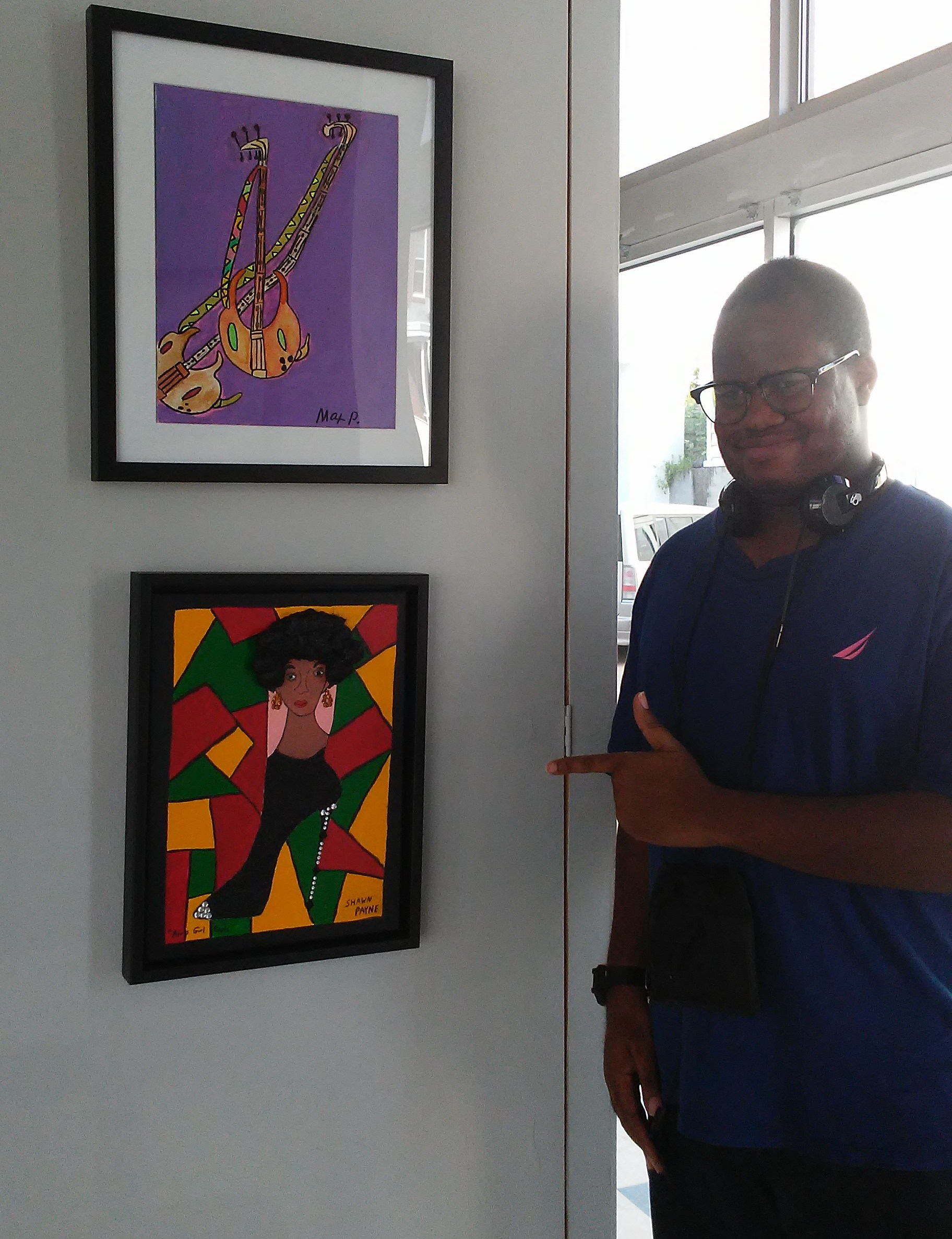
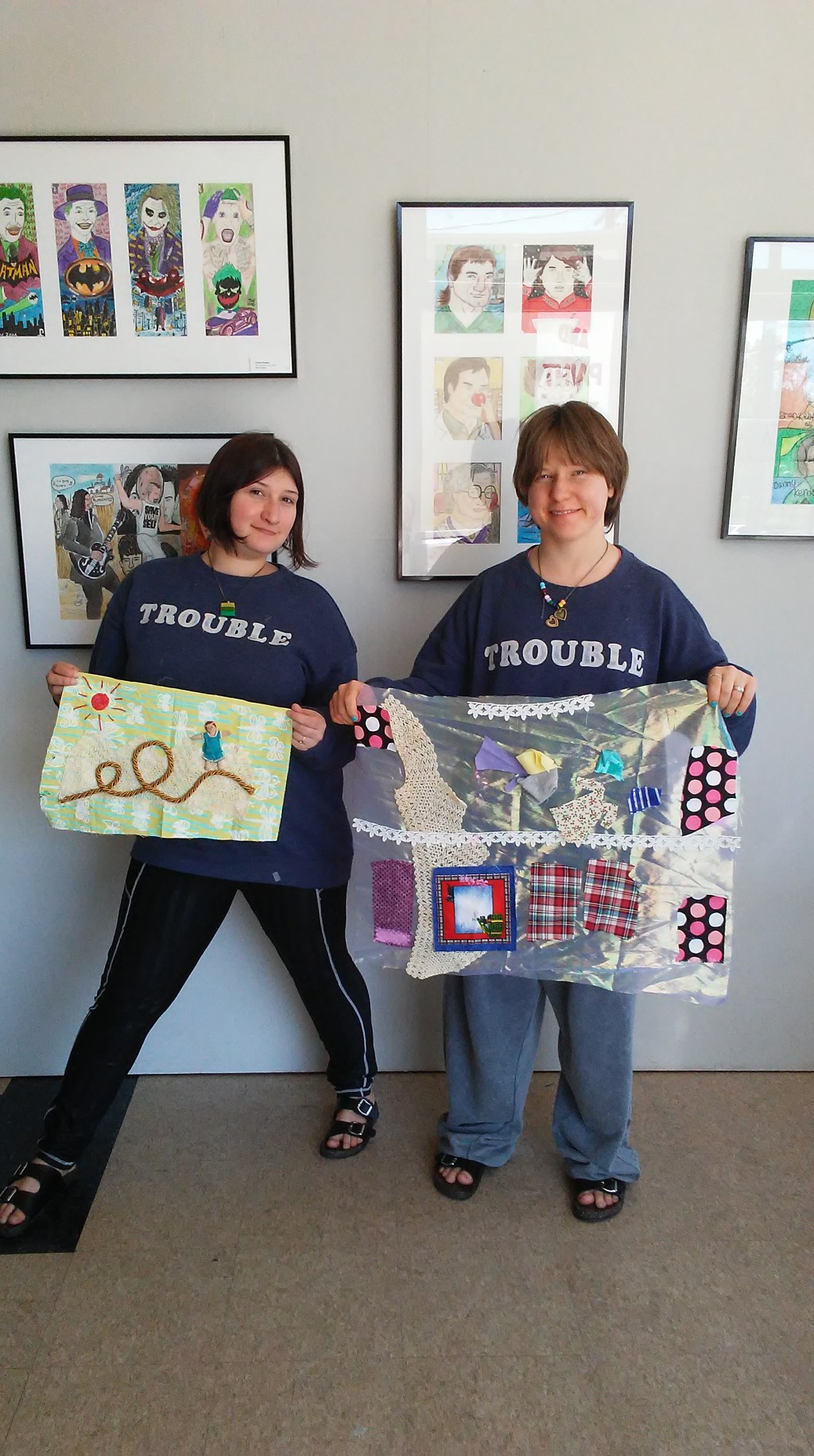
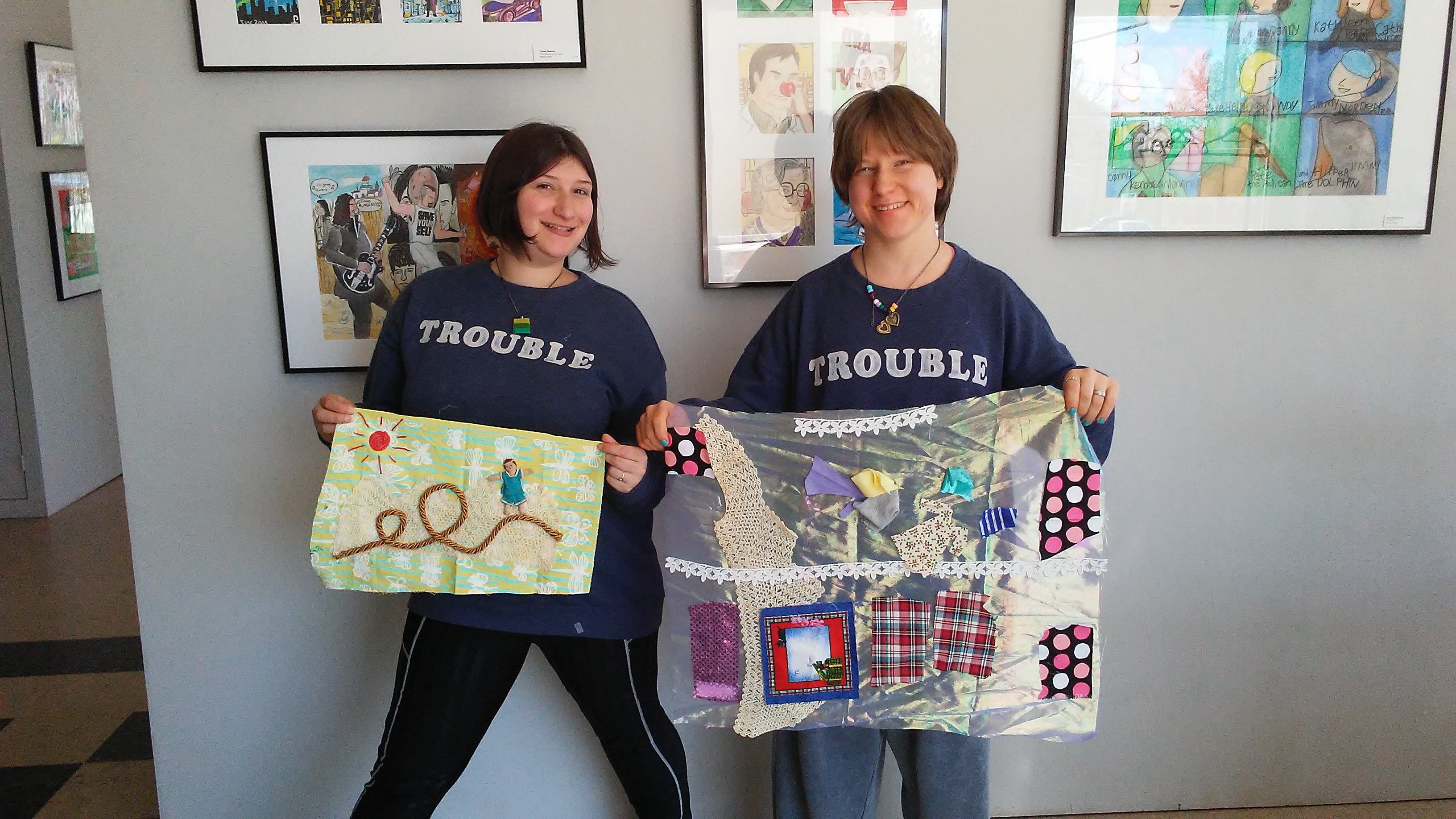
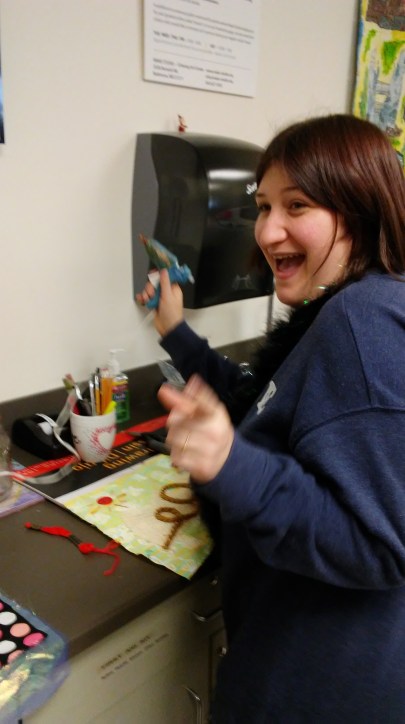
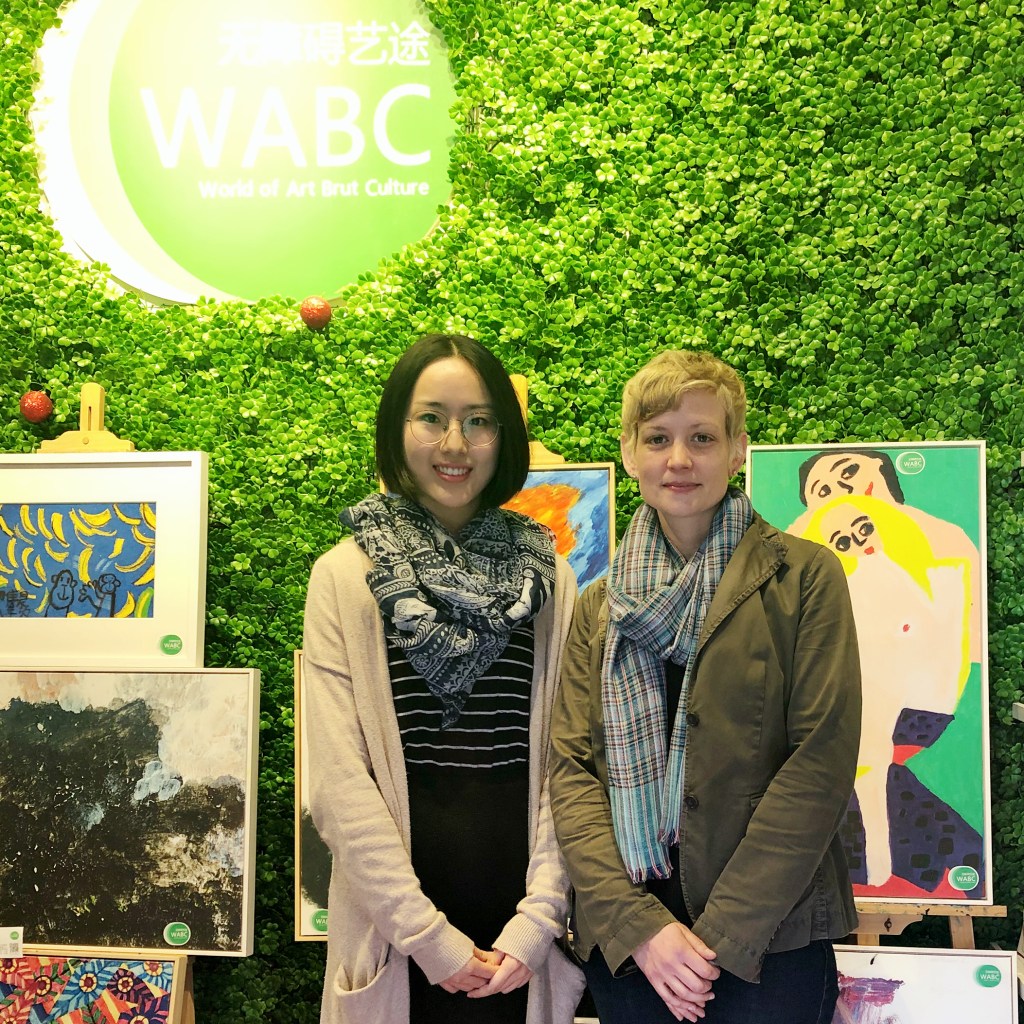
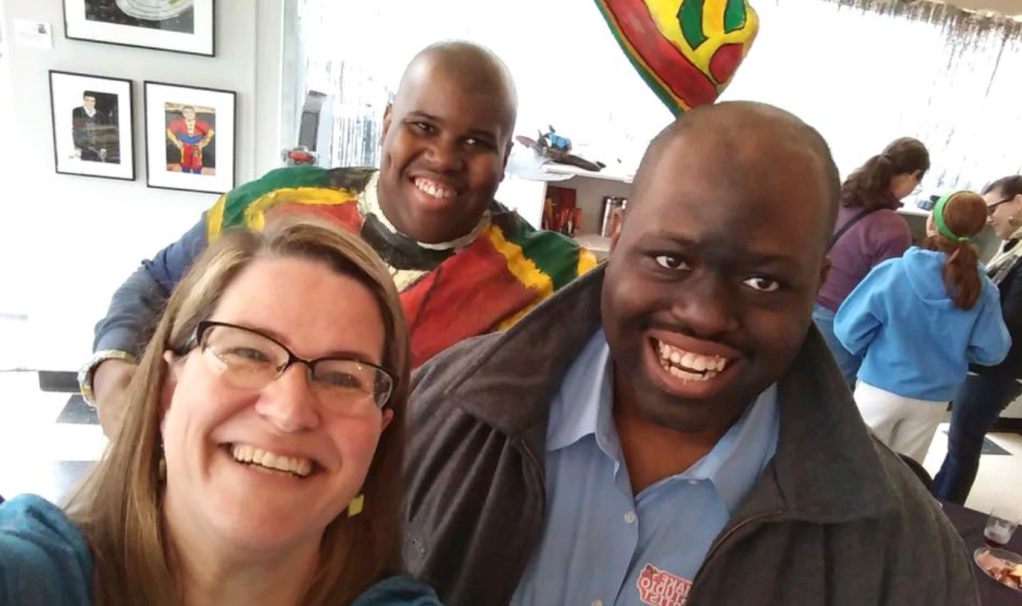
Artists Aimee and Dasha together led two workshops in one day last month, and they made sure their outfits matched for the occasion.
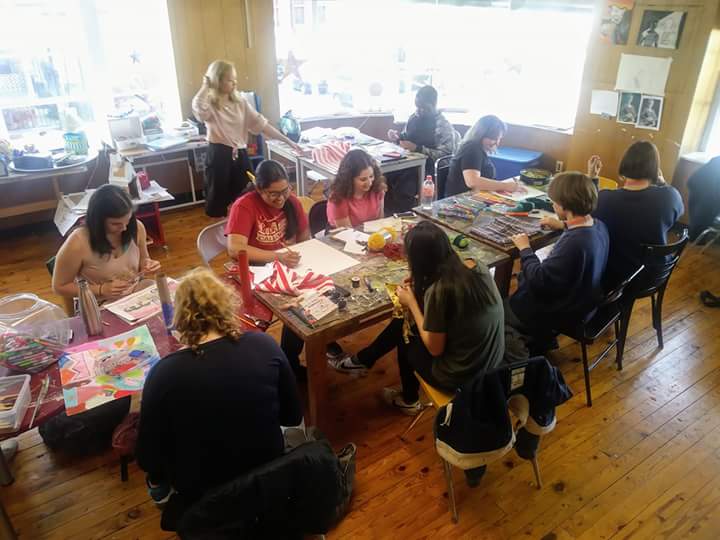
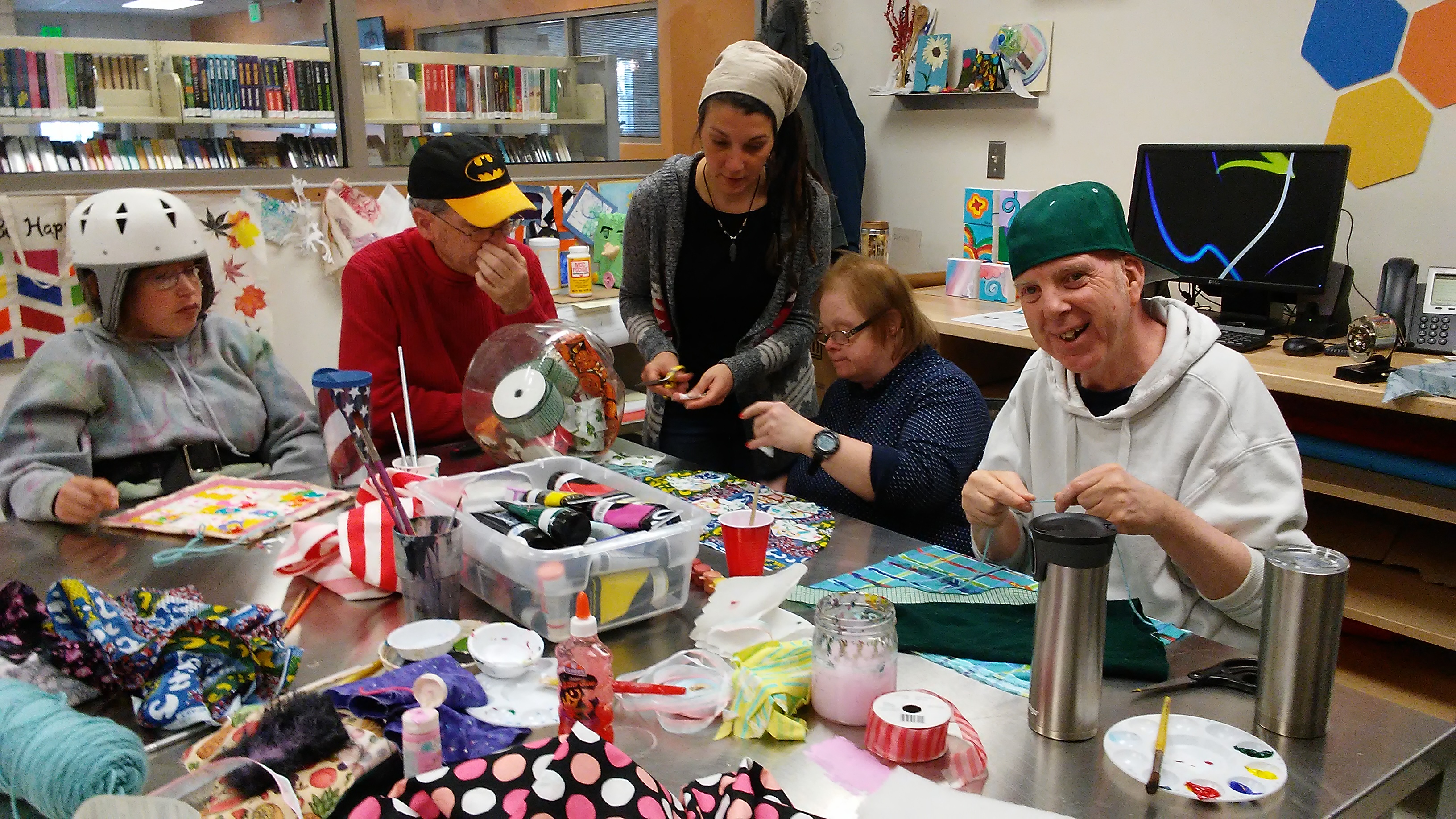
Here they share their experiences from that day, when they first demonstrated their techniques for painting on fabric at Hereford Library (as part of our “Being a Hero in Your Story” workshop series for our Inclusion in Art and Community exhibition), and then, here at our studio, co-led collaborative art-making with other Make Studio artists for students from JHU.
What as the best part about the Fabric Workshop at Hereford Library?
Dasha: I enjoyed all the people coming in and their curiosity about the project.
Aimee: It was awesome seeing how everyone felt about their work! And it was awesome to see people making their own art.
What was it like leading the workshop?
Dasha: I had fun teaching and showing off my art techniques!
Aimee: Same!
What did you learn during the workshop?
Aimee: There was a person working with fabric in a box and that was a new experience and learned from that.
Dasha: I learned how I could use yarn to hang up my piece and how thicker ribbon on the back held the fabric in place.
What did you make during the workshop?
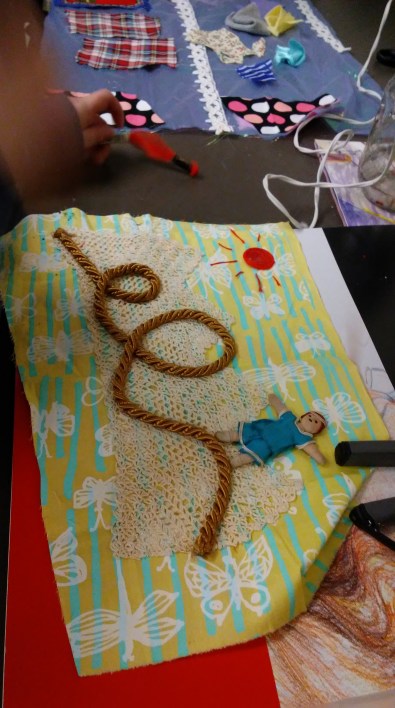
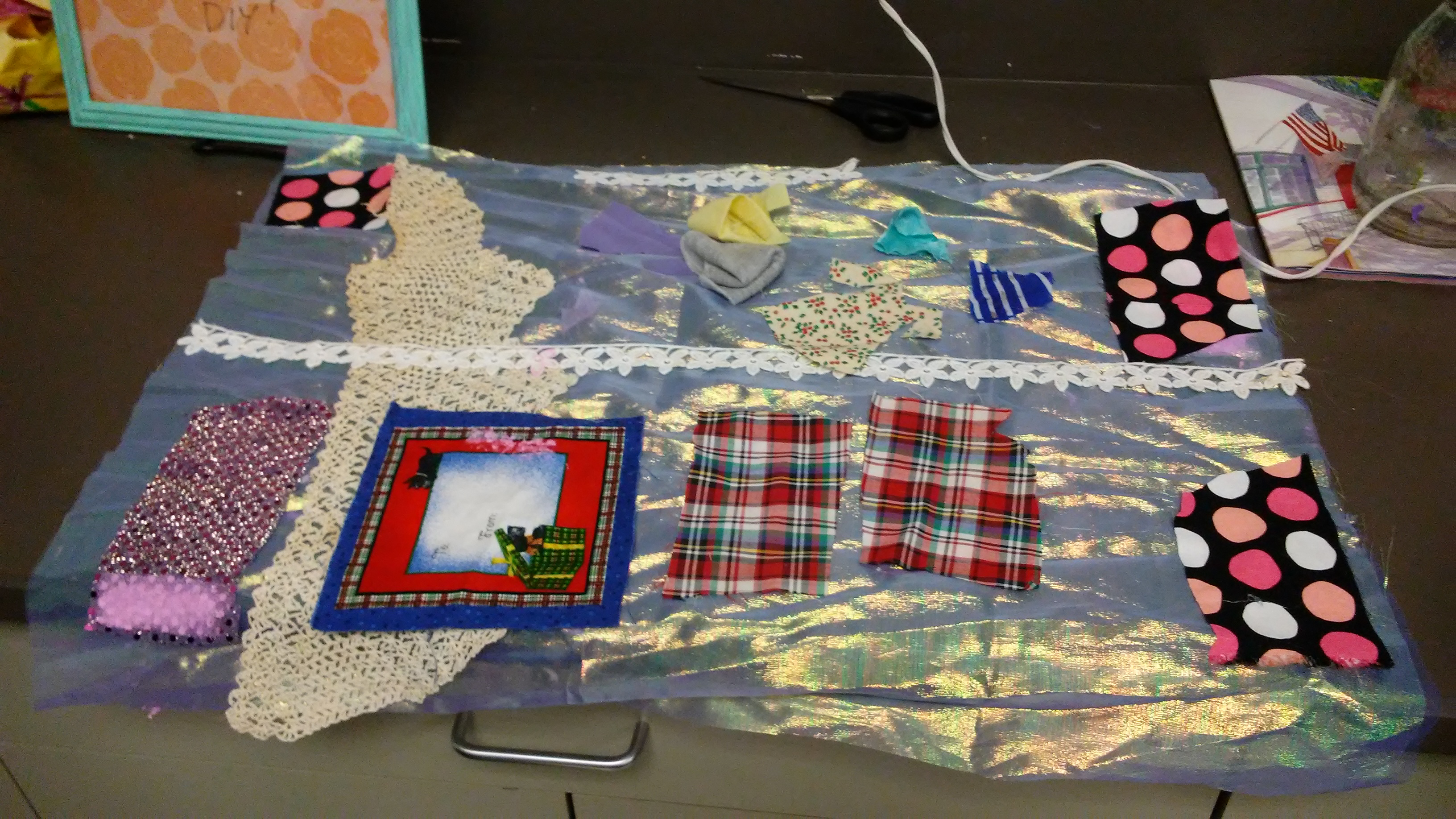
Dasha: I made a layout map of my bedroom. I used metallic fabric and glued down the fabric and folded the fabric to make the room look messy. I was thinking about the new wood floors going into my room so the art piece was a plan for my room with my new floor.
Aimee: I was remembering the ocean from a trip I took over the weekend. I found fabric that fit in with ocean colors, and used yarn and a small doll I found to pull it altogether.
What was the evening with JHU students like?
Dasha: It was good! I showed people how to sew on fabric and make a doll. I worked on a piece with Sabrina (a Make Studio intern who is also a JHU student).
Aimee: Good! I taught a person how to make Ka-Fancy (or a kitty doll). It was fun to see the Hopkin’s students working on their own projects.
Dasha: There were other Make Studio artists, lots of socializing and silliness. It was a collaborative experience. And we got pizza for dinner.
What was it like doing two workshops in one day?
Aimee: It was a lot of fun to do two workshops and there was more time to work on art.
Dasha: Some of the down time made me restless, but it was an overall positive experience.
Double Trouble’s parting thoughts:
We’re Double Trouble with fancy on the brain, creating the feel of our spirits going with the flow of fabric. Painting, sewing together, we’re growing! Art isn’t just what you see! It’s a magical adventure! Bold, subtle sometimes, our thoughts come together!
(This is the third and finalpost in a 3-part series, sharing highlights of my recent visit to China, on behalf of Make Studio and the National Committee on U.S.-China Relations (NCUSCR). You can read the first posthere. Thank you to Julia for several of the photos that appear in this series.)
In my previous post, I wrote about most of Shanghai activities with Zhu Xin’s/Julia’s organization World of Art Brut Culture (WABC). Here in this final installment of our “China series”, my goal is to wrap things up with how I shared the Make Studio message (i.e., our mission and how we and our artists put it to work) and how WABC staff and I started hatching some plans for the future.
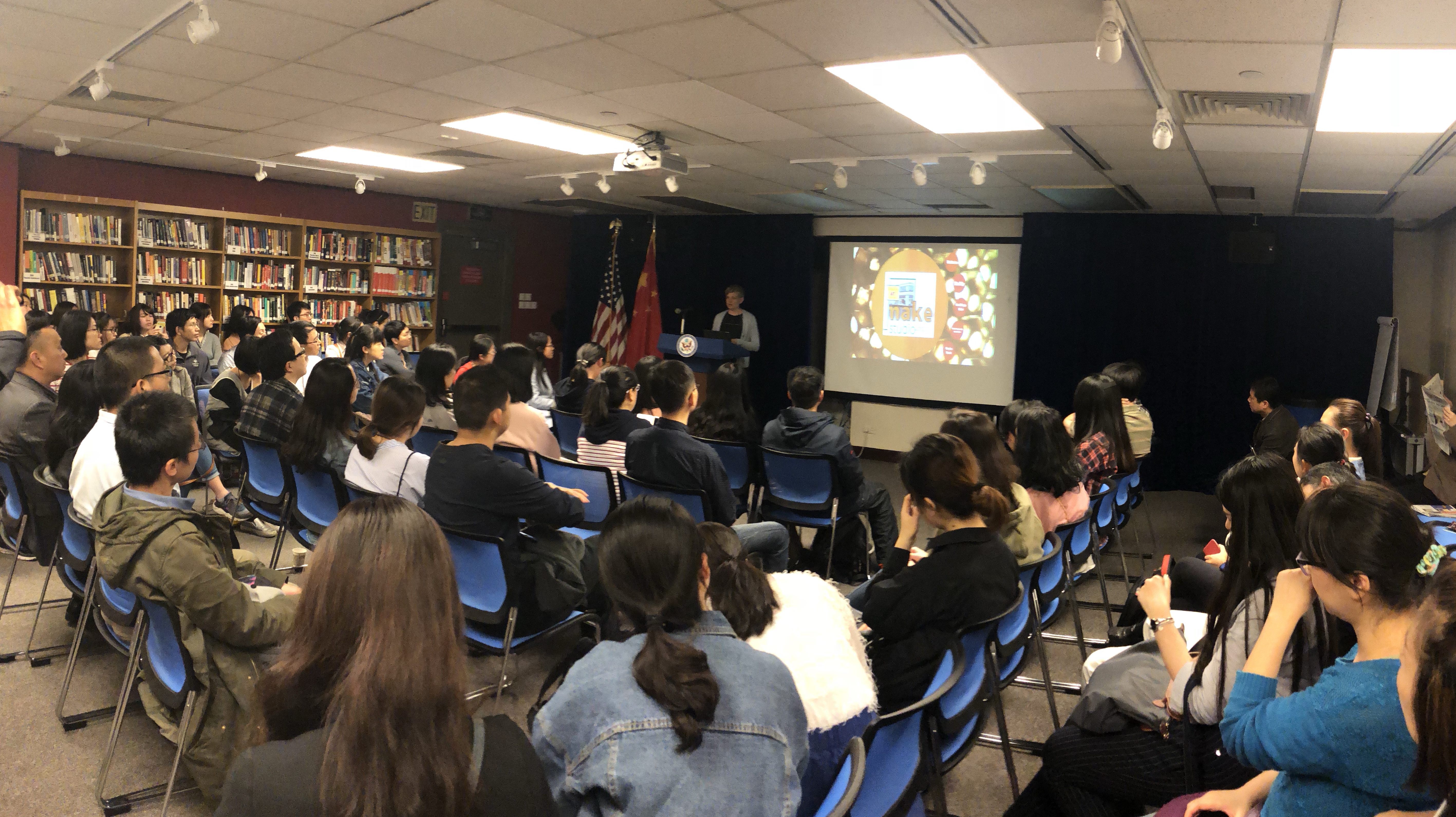
After I observed WABC studio activities and Rita’s art class one day, Julia and I went across town to the Shanghai American Center (ShAC), a program of the U.S. Consulate that hosts lectures, movies, presentations, and other programs on U.S. history, politics, society and culture. They invite U.S. and Chinese experts and academics in a variety of fields to share their experiences. As part of an evening dedicated to art therapy and related topics, on the occasion of World Health Day, I introduced Make Studio to a full room, following a presentation about clinical cross-cultural art therapy from fellow NCUSCR Fellow Ikuko Acosta. Art therapy and community arts are still relatively new concepts and fields to China, and the audience at ShAC was eager to hear from us and posed lots of interesting (and challenging) questions.
As our staff, interns, and volunteers always do when sharing Make Studio with new audiences, I emphasized that our artists are… well… ARTISTS. This audience was very receptive to learning more about what this approach to disability arts entails, how we set and maintain boundaries between “art therapy” and the vocationally-oriented work of our studio, and how we engage the wider community to further our goals of inclusion.
The next day was a busy and exciting one for WABC — one of their periodic “Open Days” when they open their doors to staff from NGOs, funders, and other interested community members. Open Days appear to provide a great avenue for WABC to share their mission, highlights of their recent activities, share contracting artists’ work, and to generate the fresh engagement and support that all nonprofits need. During this Open Day, the schedule included Rita’s and Dong’s demonstrations of techniques they use in their arts activities (audience participation required!), presentations by me on Make Studio and WABC’s co-founder and Art Director Huang Si on Outsider Art/Art Brut, and a screening of the Long Xu’s film.
This slideshow requires JavaScript.
Once again, I received fantastic questions about Make Studio, art therapy, and related topics from the audience at Open Day. In my presentation to them, I emphasized aspects of Make Studio’s model (and those of other progressive art centers) that are a bit different to WABC’s but could complement what they do. (WABC posted about Open Day on their own blog, for those who can read Mandarin.)
Less nerve-wracking for me than presenting to groups, but an equally important part of my trip, were the fascinating conversations that I had with Rita and Dong (touched on in my last post), Julia, and other WABC staff throughout my visit. In spite of language barriers, we exchanged a huge amount of information in a short period of time, and I hope they feel they learned as much as I did. I was particularly grateful that time was allotted for me to have long discussions with Beijing-based Jin Yanqing (Cynthia) and Gao Hua (Isabella) from the “WABC College team”, ably translated by Rita. We brainstormed and problem-solved about WABC’s programming, as well as their hopes to bring college-level training and more professional practices in art therapy to China.
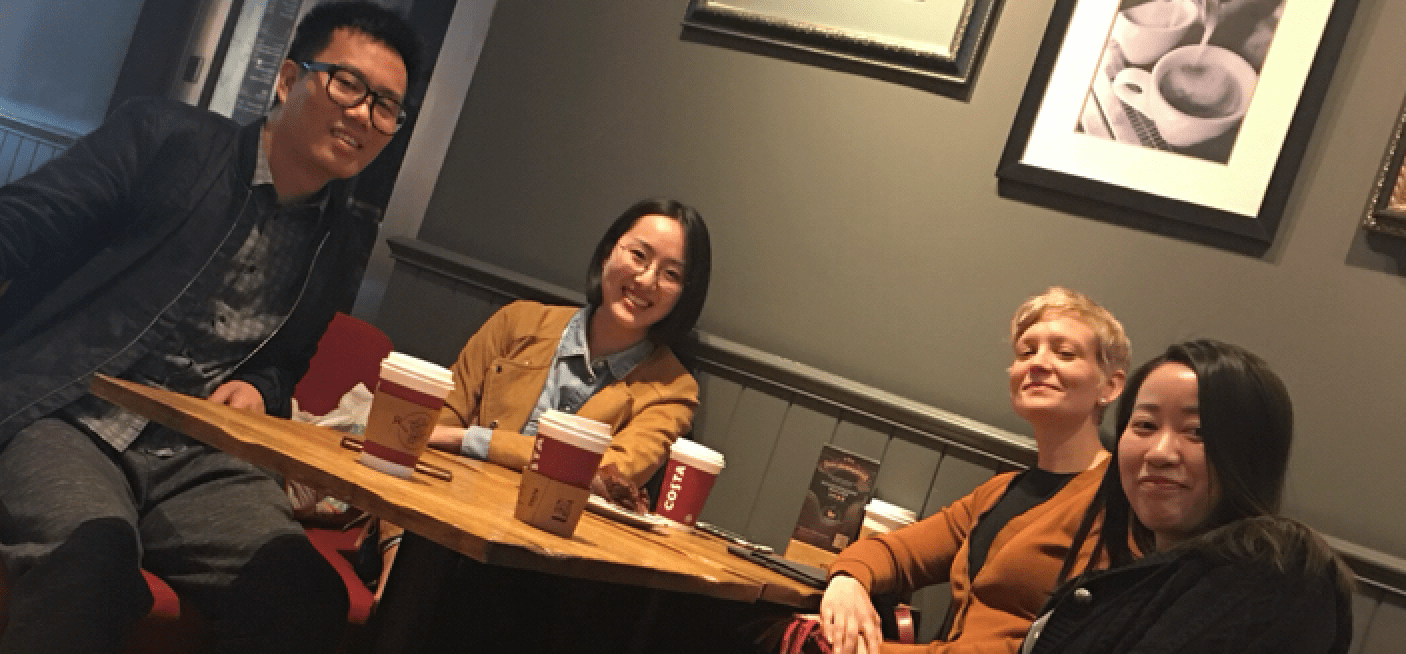
On my final full day in Shanghai, Julia, Huang Si, and Zhang Jie met with me over coffee to discuss how to foster broader and ongoing exchange and collaboration between WABC and American studios including Make Studio. Stay tuned for what comes next from this initial conversation!
Our productive early morning coffee meeting. (“Early” for both me and Julia is before 10 a.m.)
My time in China drew quickly to a close upon returning to Beijing the next morning, via a return train journey that was stream-lined from my earlier practice. I re-convened for two more days with some of the other NCUSCR fellows to trade stories about how tired we were and all that we’d seen as well as strategies for cramming souvenirs into our luggage, and did some essential last-minute site-seeing. (See a few more non-WABC specific travel pictures, below.)
This slideshow requires JavaScript.
Thank you everyone for coming along with me and Make Studio on this virtual journey, certainly a fave to be saved! We’re already beginning to follow up on all the knowledge gained and connections built with our new friends here, via NCUSCR, and in China.
Boundless thanks going out to National Commission on U.S.-China Relations, World of Art Brut Culture, and especially the smart, humble, and charming Zhu Xin!!
In my last post, I wrote about why I was in China and what my NCUSCR group’s orientation in Beijing entailed. In this installment, I’ll begin to talk about what I did in my next destination, Shanghai, especially how I spent my time with Zhu Xin’s/Julia’s organization World of Art Brut Culture (WABC).
After less than two days in Beijing, the NCUSCR U.S. Fellows each set out to the locations of their unique host organizations in different areas of China. Although WABC, founded in 2010 just like Make Studio, has 10 studios (!) throughout the country, my trip was focused on the Shanghai studio where Julia is based. So, unnecessarily large suitcase in-hand, I soon found myself on my own at one of Beijing’s dizzyingly busy train stations where there was a Dunkin’ Donuts amongst the station’s many food vendors, ensuring I had a familiar snack and caffeine for the 5-hour trip to Shanghai.
Upon arrival in Shanghai (population approx. 24 million), I was warmly greeted by WABC staff member Rita and her welcome sign with her drawing of me!
We got to know each other better — I loved learning about Rita’s artistic activities as a prolific cartoonist and illustrator and her aspirations to become an expressive therapist (!) — as she kindly assisted me in getting me to my hotel and in obtaining a local Chinese SIM card for my phone (an unforgettable experience not unlike being at our MVA, and resulting in my phone not working at all, but that is another story…).
Over the course of the next week, I would get to spend a lot more time with Rita, Julia, and other WABC staff, as well as doing a bit of exploring on my own in and around Shanghai.
Just a quick orientation to Shanghai. . . Shanghai prides itself on being uber modern and cosmopolitan and is widely considered to be China’s “capitalist showpiece”, reflected in the Shanghaieses’ embrace of smart phones, using QR codes for everything, and food delivery apps, as well as its constant traffic gridlocks and the glowing skyscrapers of its Pudong financial district (pictured below, clearly not my photo).
However, at the street level and across its diverse neighborhoods, day-to-day Shanghai still runs on traditional practices, small family businesses, scooter and bike based transport (of people and goods), and intergenerational relationships. This was very clear on my daily trips to and from WABC.
This slideshow requires JavaScript.
WABC itself is situated in a quiet oasis within the busy city, an office park of sorts created in a historical plaza to host NGOS, galleries, a civic museum, a few small businesses, and a children’s community garden.
Open space inside WAB’s plaza.
Event stage within the open space inside WAB’s plaza.
Community garden in WABC’s plaza.
WABC-created mural outside of their studio.
The WABC studio itself feels like an oasis within an oasis, always colorful and fairly quiet even when humming with the activity of art classes or staff meetings.
Front door of WABC.
Just inside the entry way.
This slideshow requires JavaScript.
On my first day with WABC, I was invited to sit in on a staff meeting (capturing the overall atmosphere, if not everything that was being discussed) and met WABC’s first artist, the very charming Long Xu, who is one of the few WABC artists that works in the studio in a way resembling Make Studio’s program artists (their program model is quite a bit different; many artists work at home or elsewhere in the community and contract with WABC). He and his mom, who works for WABC, are featured in this just released short film, “Unique As Everyone Else”.
Long Xu works in a variety of media but is currently interested in painting close ups of various animal eyes in oils, which he applies thickly with palette knife.
A recently completed frog’s eye by Long Xu.
An in-progress eye by Long Xu.
I then accompanied WABC’s artistic staff — Rita and Dong — to the weekly art classes that WABC is contracted to provide at a community “school” for adults with disabilities. Similar to day programs in the U.S., but structured like secondary settings that impart job skills training as well as academics, this is a service mode in China for people with disabilities until they are about 35. At that point, I was told, “graduates” often will stay at home with their families to help care for aging parents.
On the way to the school, Rita and Dong helped me to order a tasty and cheap on-the-go lunch of vegetarian baozi to bring on our metro ride across town.
Spicy mushroom and tofu and green veggies baozi, provided in a convenient sack for eating on-the-go.
Once there, I observed Rita and Dong lead separate groups in multimodal art activities — incorporating movement, dramatics, and drawing — that they’d each designed. (WABC provides training to instructors and volunteers, particularly about making activities accessible and inclusive, but the content of the classes I saw were driven by Rita’s and Dong’s planning.) The themes of both sessions were around social connection and appreciating others’ strengths. I was really impressed by these young instructors’ creativity and enthusiasm, as well as the talent of the participants! I could easily see that the sessions are eagerly anticipated every week — the participants met us outside as we arrived for hellos, hi-fives, and hugs.
This slideshow requires JavaScript.
Back at the studio later in the week, during a weekday class and a Saturday class, I was lucky to again be invited to observe and participate as Rita and Dong led adults with disabilities and volunteers in activities that WABC offers for free. (WABC also provides classes to children and youth.) These sessions, like those at the school, were also oriented towards connecting with others, but were more focused on exploring materials and aesthetic/sensory experiences.
This slideshow requires JavaScript.
Here I should add that Saturday classes at WABC often involve as many, or more, volunteers (folks in the green t-shirts) than participants from the community. This is indicative of the strong support that WABC has from volunteers, and perhaps more broadly reflects the growing interest in volunteerism in China especially among young people (who are not free to come on weekdays). Applying a Make Studio perspective, and seeing volunteers’ enjoyment and the deft way that Dong encouraged them to fully participate in the experience while ensuring that they didn’t try to “do for” community members, I encouraged WABC staff to consider expanding their offerings to fully inclusive workshops or classes.
Please stay tuned for the final leg of this series, Part 3, where I wrap this all up with how I shared the Make Studio message with different audiences in Shanghai and made plans for future exchanges.
Welcome sign for “WABC Open Day”, created by Rita. Find out what happened on April 12 in Part 3, coming soon.
Make Studio’s staff members don’t often contribute to this blog because it’s primarily a place for our artists to share their faves and reflections, but I’m making an exception (a small series of them). It seemed like the best way to share highlights of my recent visit to China, on behalf of Make Studio and the National Committee on U.S.-China Relations (NCUSCR), with our Make Studio family.
(This, the first post in a 3-part series, will be the wordiest one of the three. So please hang in there for parts 2 and 3, if fascinating photos are what you’re looking for!)
Photo collage of Julia’s time at Make Studio, provided by Julia.
U.S. host organizations can apply to NCUSCR to send a representative to China in a reciprocal exchange. We did, and we were honored that Make Studio was selected amongst several other, much larger organizations to participate. A few months and a lot of preparations later, and I found myself on the 13-hour flight to Beijing!
Once in Beijing, a group of the NCUSCR U.S. Fellows (excepting 2 who traveled on to Mongolia, and 1 who had to come later) received informal and formal orientations. We started with a crash course in avoiding oncoming traffic (cars, scooters, and bikes; pun intended), hailing local taxis, and “Peking-style” dining at a welcome dinner hosted for us by Irene Bao of the China Global Philanthropy Institute (CGPI).
Family-style dinner at a popular Beijing restaurant.
On our first full day in Beijing, we received an introduction to the current context for philanthropy, volunteerism, and NGOs/nonprofits in China, with a presentation from CGPI’s Vice President, Huang Haoming and a Q&A with their staff.
CGPI was founded by several philanthropists — five from China and two from the U.S. (Bill Gates and Ray Dali) — and is committed to building a knowledge system supporting the development of philanthropy for social good in China and throughout the world.
Spotted in the CGPI lobby: Bill Gate’s favorite books. Who knew?
We quickly learned that organizations in China face similar challenges to those in the U.S. — such as funding, volunteer engagement, and heavy workloads — but also deal with very different issues because “nonprofits” and “volunteerism”, as we think of them, are much newer concepts in China. There are also new laws that sharply constrain NGO’s activities.
Our understanding of these issues was then furthered by two on-site visits with staff at Beijing-based NGOs, arranged by CGPI. It turned out that I was the lucky one in our group, because both visits were highly relevant to Make Studio!
Artwork being prepped for exhibit at WABC Beijing.
The first site was WABC’s Beijing studio — giving me a sneak peek at program operations that I would later learn a lot more about at WABC’s Shanghai studio.
As a contrarian and an art therapist, I drew my dog “picking” an apple.
The whole group, however, enjoyed learning about WABC’s mission, their recent, massively successfully fundraising campaign, and experiencing an activity based on the Person Picking an Apple from a Tree (PPAT) assessment, quite familiar to American art therapists, led by a WABC art teacher.
After another decadent, traditional Beijing meal, we proceeded to our second site visit at Sany Foundation’s incubator hub. Towards their interest in “promoting scientific philanthropy”, similarly to a trending interest in non- and for profit incubation (with similar pros and cons that come with this concept), Sany Foundation incubates innovative projects in the interest of public welfare by providing them start-up funds, workspace, and other supports.
We were given a warm welcome and an informative introduction by Ying Li, Senior Program Director, in which she described how Sany’s incubator is a start-up itself and like a lot of young organizations it is working to firm up its mission, vision, and values. (These will have to remain a mystery for our non-Chinese readers and those who do not wish to take the time to translate.)
Next, the entire group was enthralled by the presentation given by Wu Di, Program Director and Co-Founder of Easy Inclusion, a social enterprise that provides disability inclusion trainings and strategies to companies to practice and benefit from inclusion.
Wu Di describes concerns of an uninformed administrator leery of hiring people with disabilities.
From Wu Di we learned about historical, problematic Chinese views on disability, which are not very different from ones we contend with in the U.S. But, also, how China’s policies regarding the employment of people with disabilities are radically different from the U.S.’s to both good and bad effect.
From both presentations, we all came away with a lot of food for thought about how policies shape our own programs, and how we can be more innovative in our approaches.
Pictured (l to r, starting top left): Heather McCann of Groundwork Lawrence, Jessica Ristich of St. Francis Community Services, Mary DeWitt-Dia of American Red Cross, Margot Landman of NCUSCR, CGPI host and intern (regrettably, names missing), Wu Di, Ying Li, and me.
Although our orientation in Beijing was brief, it provided me with loads of context to help me better understand what I’d go on to see and learn during the next leg of my trip in Shanghai.
Please stay tuned for Parts 2 and 3 of this series, coming soon, where I’ll share many images, and much fewer jet lagged words, from WABC Shanghai!
Make Studio celebrates our 8th anniversary starting on Saturday, February 24th with a special exhibition, “Go Figure”, in our Showroom Gallery featuring new works by our 30+ program artists, who explore materials and subject matter “eight ways to Sunday”. Recently, artist Dontavious Woody has similarly been a explorer in his own right, doing multiple, varied versions of images that he finds inspiring.
Rosie E. asked him to talk about his recent “The Lovers” series, based on Gustav Klimt’s famous piece, “The Kiss”.
You have done this image several times. What do you like about it?
The people in it. I like the way they are together.
How are the people?
Passionate together.
What do you like about your latest piece in progress (one of another set of multiples, inspired by a photo of people wearing striped shirts)?
It like my family, so.
What do you do with your family?
Everything.
Who is pictured in “The Lovers”?
Stefan and his girlfriend (wife).
Why did you make multiple versions?
Because Cathy seen my piece today and she liked it.
What changed between the earlier version and the later version?
Different: the background surrouding the lovers and the ground underneath them.
What did you change and add when working from Klimt’s piece?
Different color.
Why do you like drawing people?
I like drawing people because you get to see how they live and what they are doing.
You have done a lot of fashion work previously. Does this piece have to do with fashion?
It could be connected to fashion.
What do you want to tell people about the upcoming show?
They should come to it.
Woody will be at the “Go Figure” reception on Saturday, join him there! Both versions of “The Lovers” pictured here will be on sale alongside the top version in sticker format.
In partnership with Baltimore City’s Recreation and Parks Division, Make Studio leads weekly art classes for adults at Farring-Baybrook Therapeutic Recreation Center.
Offering four classes weekly to 7 to 25 participants, instructors invite these artists to try new materials and methods, be self-expressive, and connect with each other and their communities through art. Informed by the ideas and creativity of our amazing participants, we facilitate projects and discussions around topics of nature and self-awareness, creative solutions, culture, and society.
This past month, Farring Baybrook artists had a special opportunity to participate in an off-site art workshop at Cylburn Arboretum, a local city park that unites nature and the urban environment. As part of the workshop, the artists had achance to tour the Johns Hopkins Center for a Livable Future, Food Systems Labto learn about their unique aquaponics garden and greenhouse. Participants were introduced to key concepts of sustainable fish farming, seeding and planting, worm compost and harvesting. Participants and staff were both encouraged to explore and interact with the greenhouse environment.
Of course, as artists, the group couldn’t help but roll up their sleeves and get hands-on by feeding fish, tasting freshly grown vegetables, and even discovering worms with their bare hands!
After the greenhouse tour, the participants entered the workshop room where they were invited to create artwork in response to their experience in the natural environment. Working with watercolor and colored pencils, the artists took inspiration from aquaculture and plant life to create diversely wild and whimsical paintings.
The artists’ paintings from the workshop, and colorful branch wrappings from the classroom were then curated along with other nature-inspired works from Make Studio artists, and were altogether featured at Cylbrun’s Vollmer Center in a collaborative exhibition called Wild and Green. The show comes down today, but in addition to photos here, you can check out anything you missed on Make Studio’s Facebook page.
Stay tuned for future news from our work with BCRP artists!
Aimee Eliason started working at Make Studio in 2015.
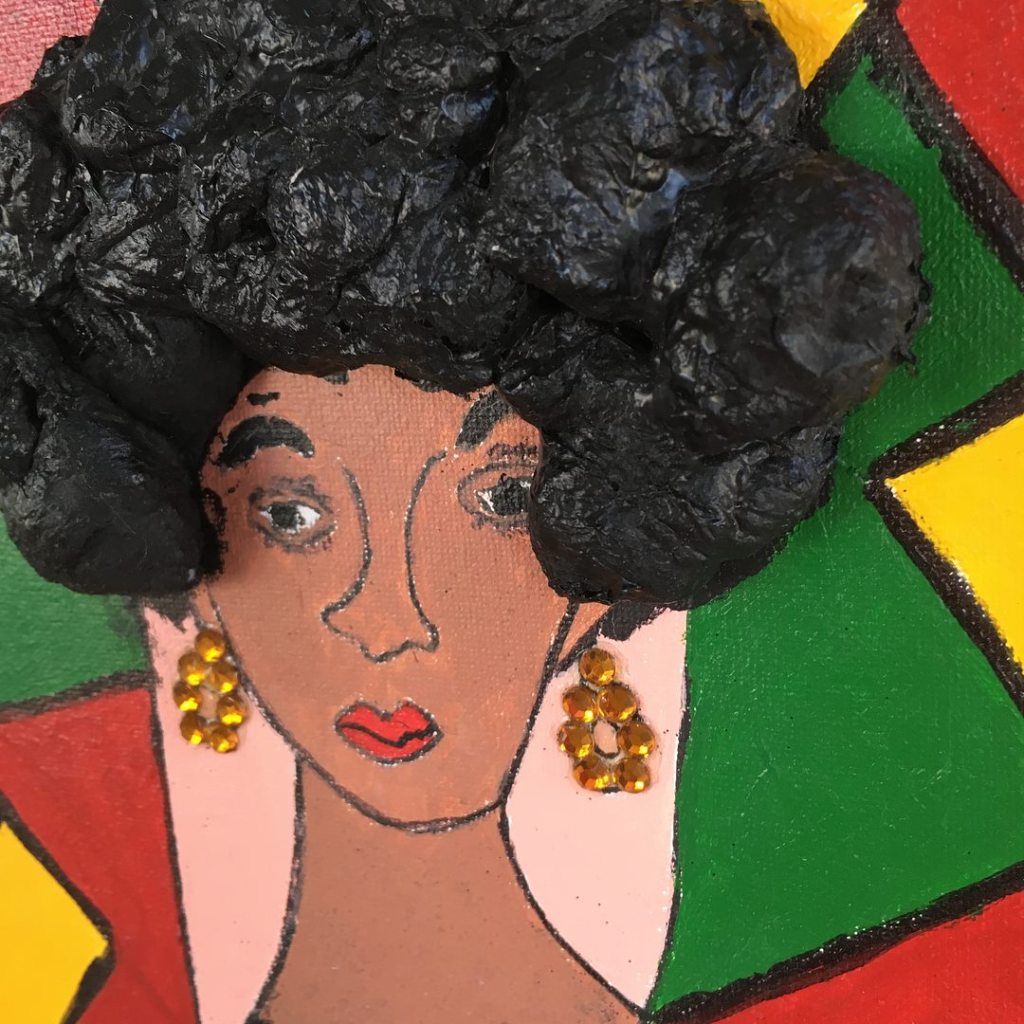
Right now Aimee is focusing on sculpture with found objects, including wearable art such as this “Christmas hairpiece”.
Aimee enjoys having unstructured time to explore her creative ideas in the studio, where many media are readily available. She also likes having opportunities to work with visiting artists as well as to collaborate with other Make Studio artists.
“Sometimes I have really wacky dreams, if I can remember them when I wake up I like to do oil paintings or acrylics based on them.”
She also finds inspiration in her hobby of ice skating, which is “exciting, exhilarating, and calm all at the same time.”
“Oil paint is life!”
However, Aimee also is lately painting with acrylic on fabric or turning fabric into other fun creations, such as her hairpieces.
Aimee models with another one of her custom hairpieces.
It’s National Disability Employment Awareness Month, a time to reflect on and take meaningful steps toward creating workplaces that welcome the talents of all people. Employment is a significant way to empower individuals with disabilities — helping them work toward independence, full community participation, and economic self-sufficiency.
At Make Studio, we cultivate an inclusive work place, providing broad exhibition and sales opportunities, a work place that is welcoming to all, and opportunities to act regularly as teaching and presenting artists in the wider community beyond the studio.
We also support our artists’ efforts to maintain other employment in their immediate communities. Our artists work in varied settings including retail, food service, maintenance, and office settings, as well as in the studio as self-employed professional artists. Chuck, Dasha, and a newer artist, Katelynn, recently sought new employment opportunities. In celebration of this important month, they wanted to share a bit of their recent employment experiences.
Dasha:
I worked hard to get my job at Lord and Taylor.
I presented well and I looked professional at the interview. And it all paid off. I was hired on the spot.
My first few days at work were shaky. I didn’t know my tasks real well. And I struggled with the register. I got hung up a couple of times, but I did get the help I needed and the other co-workers and managers are very patient and understanding.
I did tell them I am an individual with disabilities.
Now I’m doing much better. I finally got the hang of the register and I am ringing up customers with no problem at all. And now I know my other tasks I need to do during the day. Everything is going much smoother and I’m able to manage my day. So far I like my job. It is easy and challenging all at once. I enjoy my break time too!
Chuck:
The job is at Canton Carwash in White Marsh. I found this job because I had been there before with family and staff from my house and I liked the way they did the rims.
I clean the van at EMERGE once a week inside and out and I do a good job for them. My staff told me that I do a good job with that. One day I went online and did the application online. I put that on my application because I am good at cleaning! They called me back- me and my job coach- and I got the job! Now, I’m waiting on paperwork- copies of things and figuring out transportation, you know, waiting.
They are really eager to help me though to do the job right. My goal is to get better at time management on the job. I don’t like to be rushed. For me, that will be a challenge. I also work at Make Studio and there I can work on pieces slowly over days sometimes weeks. I work at the EMERGE greenhouse, too, and there on lawn crew, the pace is a faster because we might have three lawns to do and a certain amount of time to do it. This November, I’ll have been at the greenhouse thirteen years! It’s fun.
I got to keep in my mind that like my other jobs the car wash is a job and I have to do it in a timely fashion, but still a good job and I will DO a good job! The manager of the car wash will be a good manager for me because he told me that he would put me under his wing because he has a family member with a disability, too. I thought that was pretty cool- he kinda knows and understands what it might be like to have a disability. I will be wiping down the cars, drying them off and detailing rims! I can’t wait!
Katelynn:
A few weeks ago, I applied on Indeed with a resume and phone number for a job as a dog groomer. I currently have a professional animal worker certificate (PAWS) and Canine and Feline first aid CPR cards.
The owner of a pet salon contacted me for an interview in two to three days as a result of me posting my resume. I wore an interview suit because I did not expect to demonstrate my skills as a dog washer. I was hired and now work in Timonium!
I wash dogs, do laundry, and generalized cleaning. I LOVE my job working with dogs every day. I work five days week, averaging 20+ hours per week, Tuesday through Saturday. Because I use Mobility to go back and forth to work I am allowed to arrive between 8:30 and 9:00 in the morning and leave when the last dog is washed but no later than 2:00 pm.
For now, I am taking a break from Make Studio while I continue to adjust to my new job. I hope to be back in the studio in the new year- I miss working at Make Studio!
This blog is a review of the Season 1 episode of Futurama entitled A Fishful of Dollars. In the episode, Fry becomes rich and gains 4.3 billion dollars after discovering that over the course of the thousand years he has been frozen that his account had grown a large amount of interest per year.
Futurama manages to be a smart show, even when it focuses on a dumb character and I think that’s where another one of its strengths come into play. The animation is gorgeous, but it is only one of many things I admire about the show.
The episode plays on themes of nostalgia and gaining material possessions while realizing the importance of what is already gained that can’t be purchased with money, like friends and loved ones. It also shows that some things can’t be bought back even with money, but can still be missed.
In the episode, Fry dreams up an advertisement for Light Speed brand briefs. In the year 3000, people’s dreams can now contain commercials just like on billboards, television, movies and in the sky. Fry and his coworkers know that they don’t have to do everything the commercials tell them to, but rush off to buy a whole bunch of stuff anyway. Yes, even a thousand years from now, commercials are still a primary source in determining what to buy. The only difference is that we’re seeing those ads during Rapid Eye Movement sleep.
When Bender is caught shoplifting Mom’s valuable Robot Oil and arrested, Fry goes to the bank to get the money for Bender’s bail and realizes that during the time he was frozen that his measly 93 cents from the 1990s has now turned into a whopping 4.3 billion dollars. The teller even has to blow the dust off of the machine in order to gain access to it. Apparently, nobody is freaked out that someone is actually able to gain access to a thousand year account. Someone who would probably already had been fossilized by now is able to still go to the bank and use their dusty old account and everybody is oblivious to this. It’s that brand of oddness that plays into the hilarity of the situation.
Back to the episode, Fry is now a billionaire and treats himself and his friends to various things that range from surprisingly fun to incredibly clichéd and ridiculous (Including top hats that make you realize “just how rich someone is”). Shooting priceless artwork with lasers is now a thing rich people do, instead of purchasing them since, in the year 3000, nobody cares about paintings.
Then, Fry treats his friends to a pizza, but causes the robot waiter to explode from confusion when he asks for anchovies as a topping. Anchovies are now extinct, due to Zoidberg’s species (who are dangerously addicted to them) suddenly fishing and eating them all. I love Zoidberg’s reaction when he’s called out on this and he suddenly cracks and confesses that he and his people ate all of the anchovies. It’s what I feel is the first of many glimpses into Zoidberg’s hilarious eating which comes into play in countless situations, some more random than others.
Bender leads Fry to an auction that allows people to purchase stuff from his time, including an antique robot toy (Rock Em Sock Em Robots). One of the items is surprisingly a can of anchovies, the last existing ones ever. Fry and an old lady named Mom get into a bidding war over the can, which Fry wins after buying all of the other stuff in the auction as well. This act of greed and depriving an old lady of something disgusts everyone, even the auctioneer.
When Fry’s friends try to tell him living in the past isn’t healthy, he rejects his friends in favor of his new retro 20th century stuff. Mom and her sons plan to bankrupt Fry out of his money so he’ll sell Mom his anchovies. They are easily able to rob Fry of his money when they find out the pin number he foolishly says out loud to everyone when they trick him into thinking it is still the past. But Fry decides not to sell the anchovies and serves them to his friends on a pizza for them all to eat, thus ridding the world of anchovies for good. However, Zoidberg, the only one who liked them, threatens Fry for seconds and the episode ends there.
This episode begins and ends with jokes that lift off effectively, stay relevant to the episode and what’s going on in the episode and ends with the type of closure that never leaves anything open ended unless it’s for comic effect.
It’s not just the jokes that impressed me. It was the writing. The writing manages to really get out everything it has to say about nostalgia and friendship. The prospect of someone being able to fool someone out of all of the money in their bank account as Mom’s sons did with Fry and their ridiculous plan was just worth its weight in laughs. But what helps sell the moment even further was the fact that the plan was actually working.
Fry’s brand of stupidity works for a lot of laughs and that’s due in large part to the fact that the show tries new things and situations to put Fry’s stupidity into effect.
Again, the show can focus on an aggressively dumb character and still maintain its wit and intelligent humor. That’s what episode 6 did and it managed to succeed at it.
(Staff note: Jerry “Partyman” Williams is not the only circus fan at Make Studio! Kareem shares his photos of and thoughts about RBB&B circus’ final visit to Baltimore.)
I went to see the circus for the final time at this amazing arena & the last event for the circus called, “Out Of The World”.
I saw the new stage for the circus & I met the funniest clown for the first time, before the show begins.
They had lots of entertainment like basketball players with tricycles, animals, clowns & more. Also, I saw the Ringmaster at the circus.
I saw The Princess , who entertained the people in the arena & she rode a horse with the guys riding the horses too. The fans loved it!
All the circus performers did an amazing speculator job there in the arena & we say “Goodbye” & “Thank You” to them for the laughs, hearts & memories to the people of Ringling Brothers & Barnum & Bailey circus.