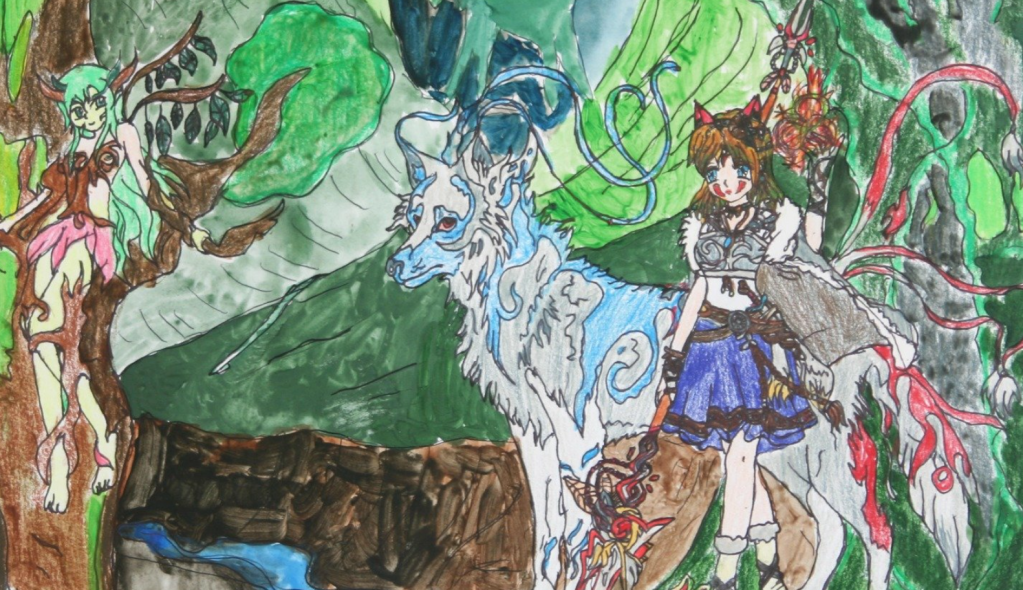
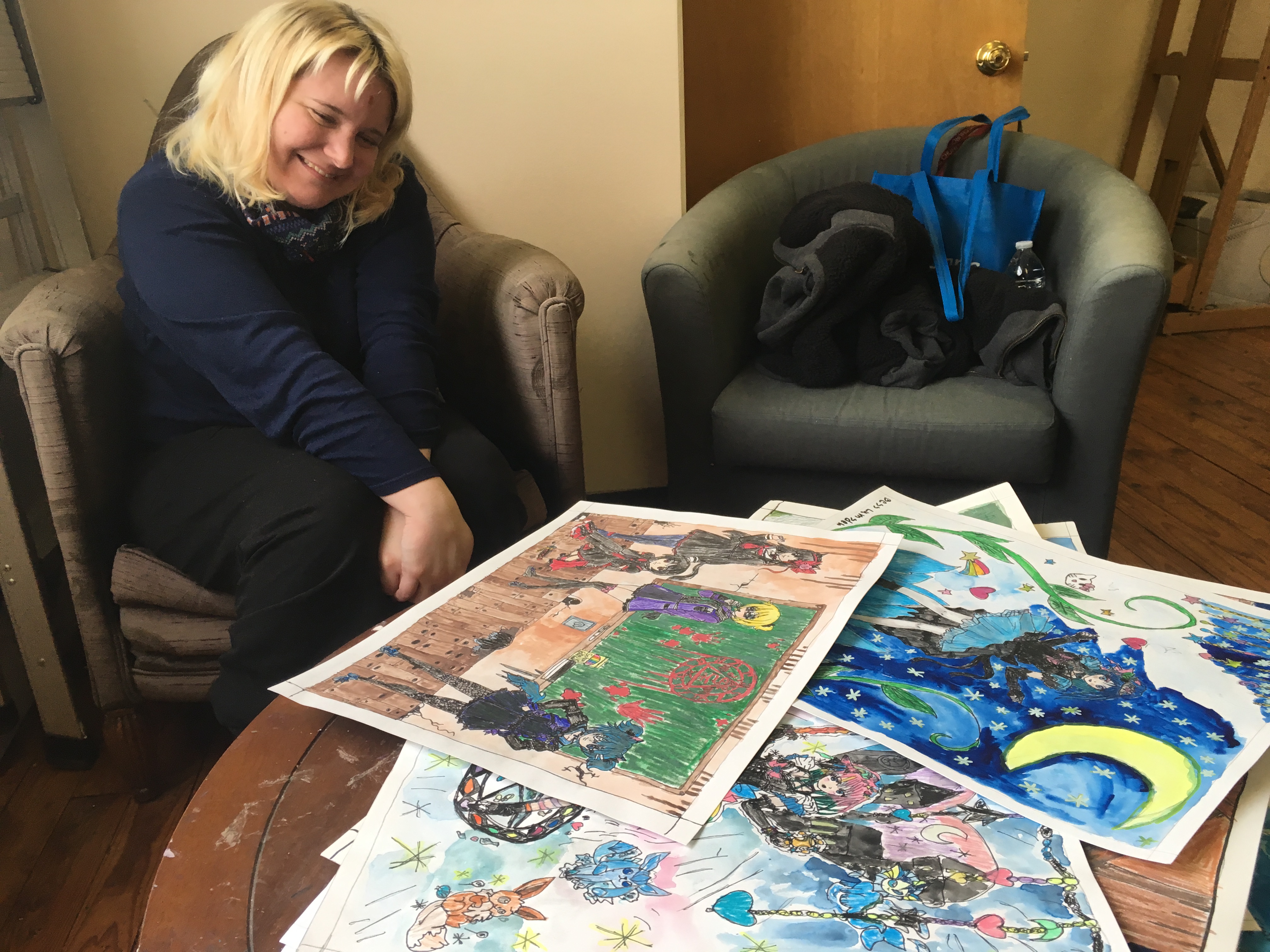
Bess’ recent bliss comes from returning to an old favorite activity– creating anime-inspired art. Specifically… magical girls!
She’s been busy creating self-portraits as a “magical girl” with all kinds of “strange components,” like halos and wings. She’s “grateful” no one is saying she will “never get anime art published because ‘it’s not art – you’ll never make money off of it!’” (She’s heard that a time, or two. Bess would like to point out that people who said this were wrong.)
Her current work-in-progress is an “anime-cyborg girl who you wouldn’t want to mess with during the zombie apocalypse.”At home, she is working on a written fan fiction that features this character.
Despite the larger commercial success of “magical girls” in Japan, Bess brings her enthusiasm for her material to us in the U.S., and adds her own spin. Her magical girls are not just magical, they are also “creepy, horrifying girls!”
Outside of Make Studio lately, Bess is on cloud nine when going to the movies and visiting the Walters Art Museum in Baltimore with her boyfriend.
Make Studio artists are counting down each day until our ninth anniversary celebration by sharing something that puts them on cloud nine.To help us celebrate, join them here on the blog all month through February 22nd, and in-person on February 23rd atCloud 9!
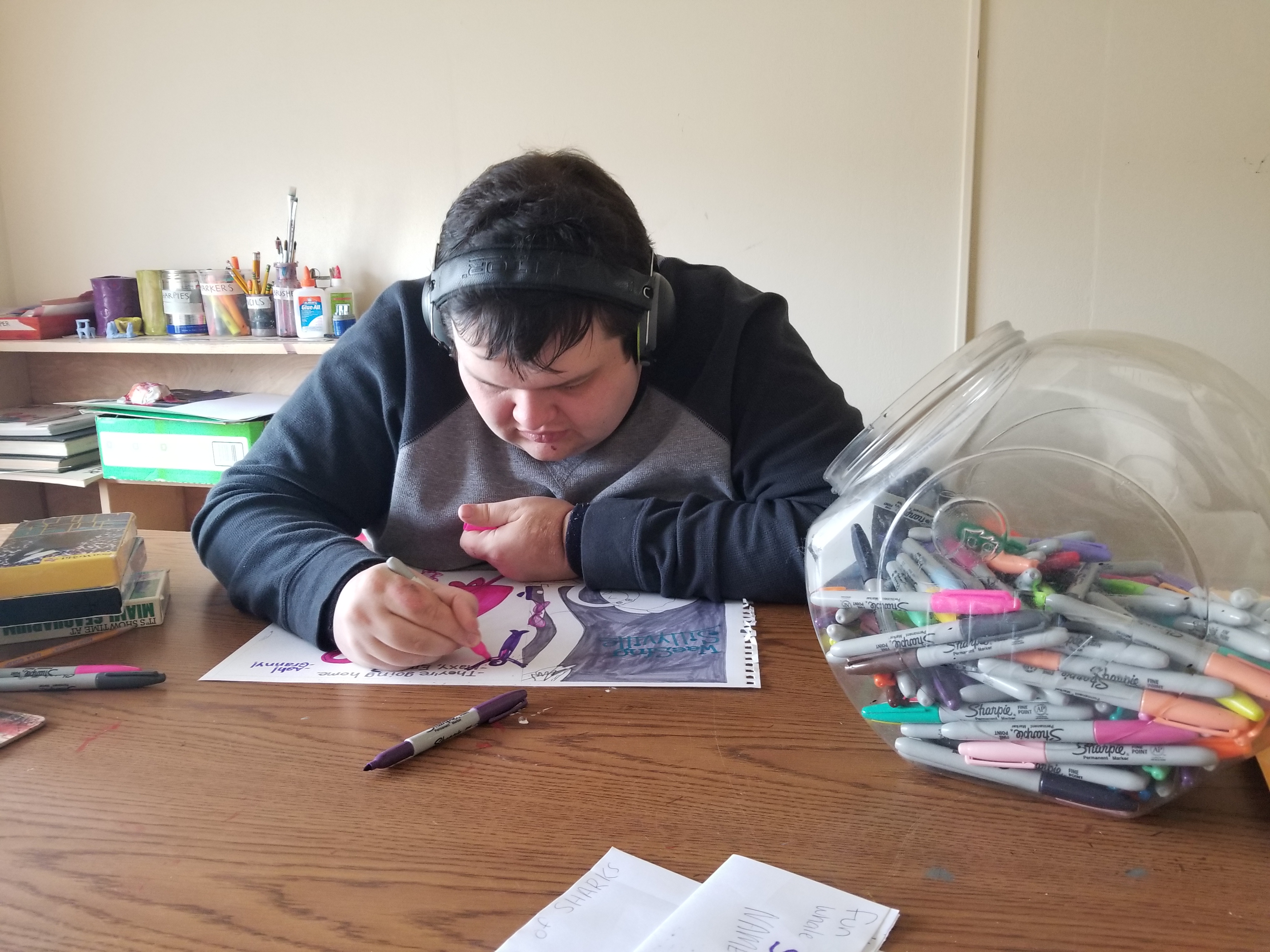
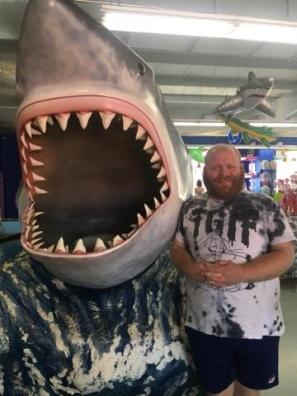
Wondering what puts Jimmy “on cloud nine”? He made us four lists of four, which can mostly be found under the sea.
Four favorite TV shows:
Shamu TV
SeaRescue
Phineas and Ferb
Toy Story
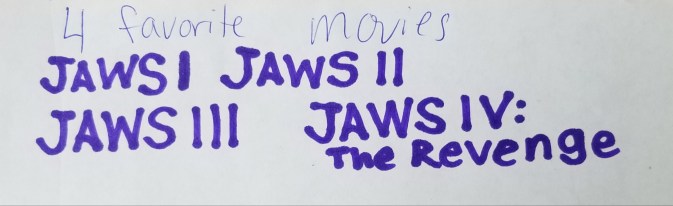
Four favorite movies:
Jaws I
Jaws II
Jaws III
Jaws IV: The Revenge
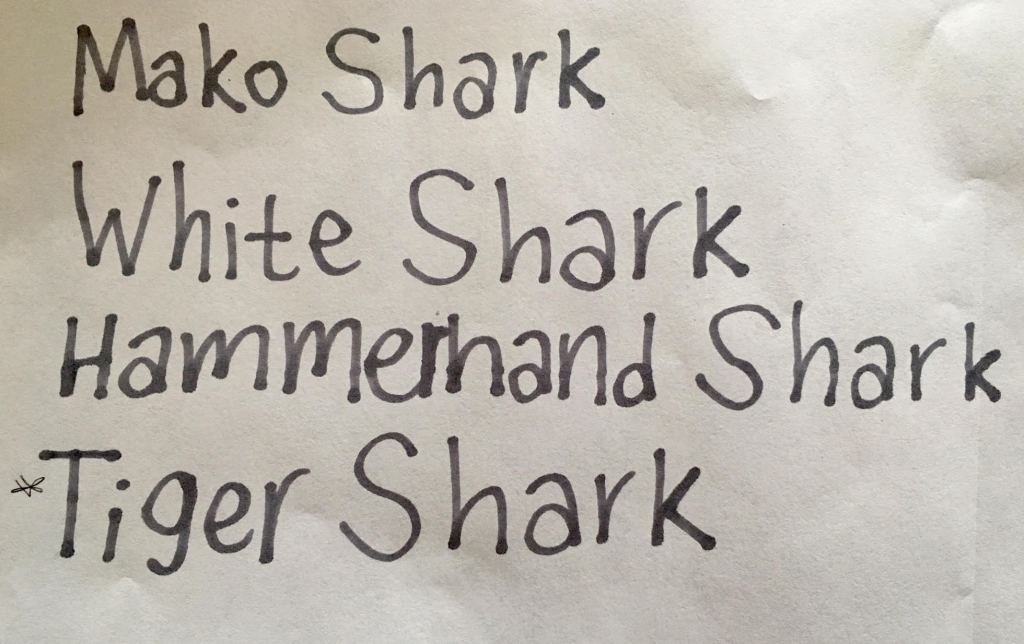
Four notable sharks:
Mako shark
White shark
Hammerhead shark
Tiger shark*
*The tiger shark is Jimmy’s favorite shark.
Four favorite animals:
False killer whales*
Beluga whales
Pilot whales
Killer whales
* Jimmy says that the difference between false killer whales and real killer whales is that, while they both eat fish, the killer whale is a type of black and white orca and the false killer whale is only black. After a little research, we also found out that the false killer whale is actually a type of dolphin.
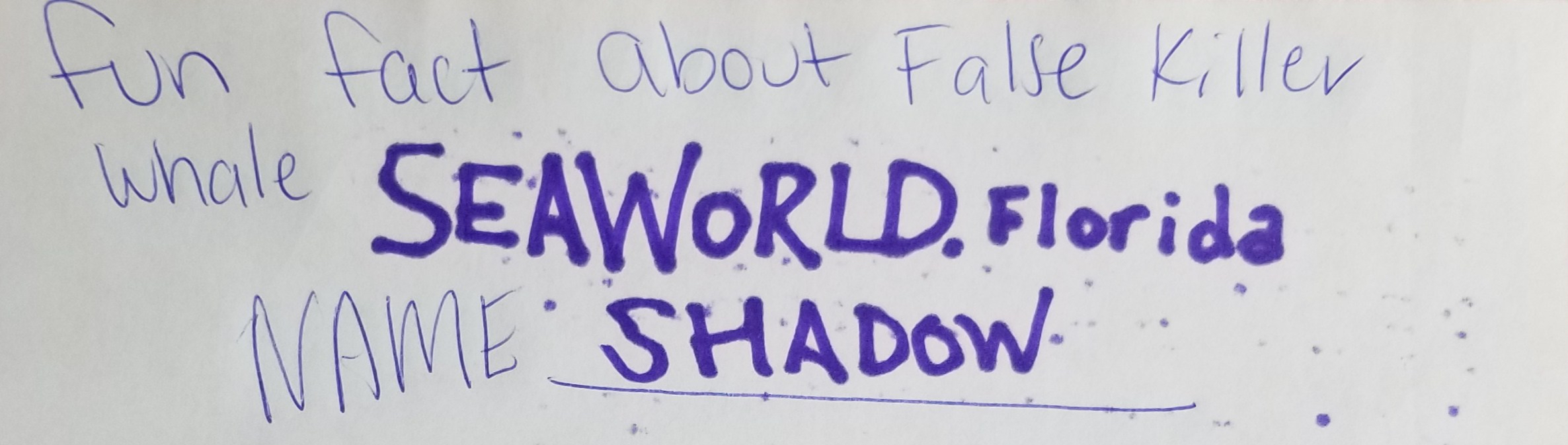
Jimmy also told us one fun fact! There is one false killer whale, at SeaWorld Florida, named Shadow.
Make Studio artists are counting down each day until our ninth anniversary celebration by sharing something that puts them on cloud nine. To help us celebrate, join them here on the blog all month through February 22nd, and in-person on February 23rd atCloud 9!
The holidays are coming. Have you ever looked for artwork to give as presents? Check out our artwork! You can find artwork on my page and other make studio art pages. After you find something you like, go to make studio’s main webpage and find out how to buy your favorite artwork!
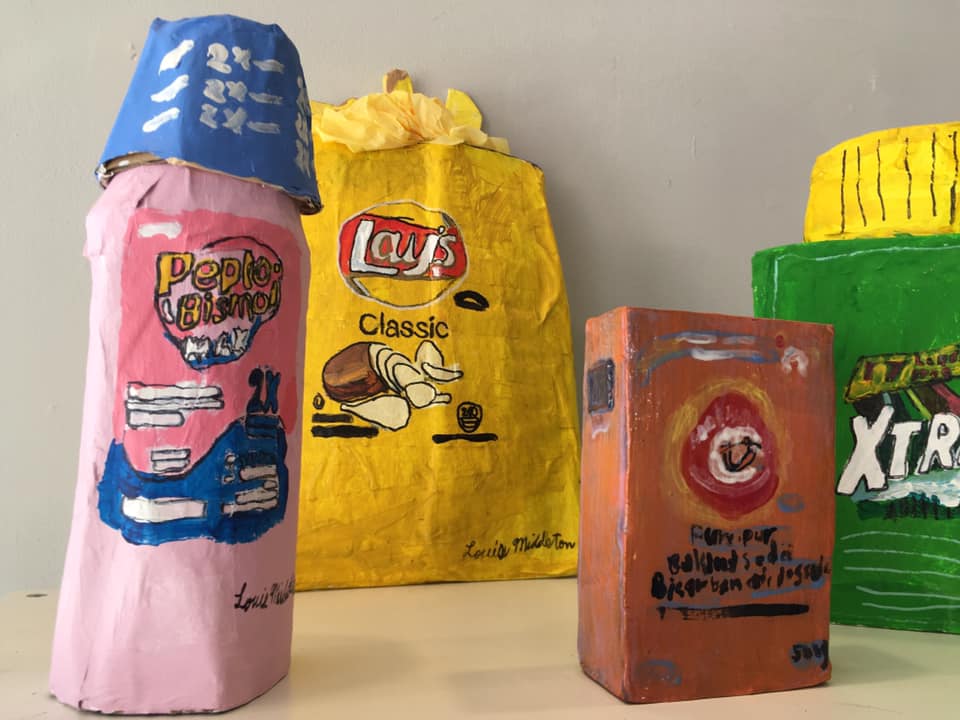
We are having special gallery shopping times too. There are a lot of things and art for sale that you can only see in the gallery like my grocery items made with cardboard and clay. My inspiration is from the game show Supermarket Sweep. So come by and shop for cool, nice stuff!
For Free Fall 2018, Make Studio is pleased to present Cordially Invited, a first-of-its-kind in Baltimore invitational exhibition and set of programming featuring artworks created in innovative U.S. and international studios that serve artists with disabilities.
Cordially Invited celebrates the exciting and thought-provoking art produced in progressive art studios as a way to better appreciate our neuro-diverse world. Opening Friday, October 5 is a central exhibition in Make Studio’s Showroom Gallery, with smaller displays “popping up” in partnering neighborhood venues, and a digital exhibition of non-U.S. artists coming online, soon after and remaining up for at least a month.
Artist Tyrone Weedon provided this review of the show as it went up:
I like artists who do their own thing. I really enjoy all the various artists styles. It’s important not to judge someone’s talent because we are all artists. I saw pieces that reminded me of Make Studio work, but I also saw pieces that were new and fresh to me.
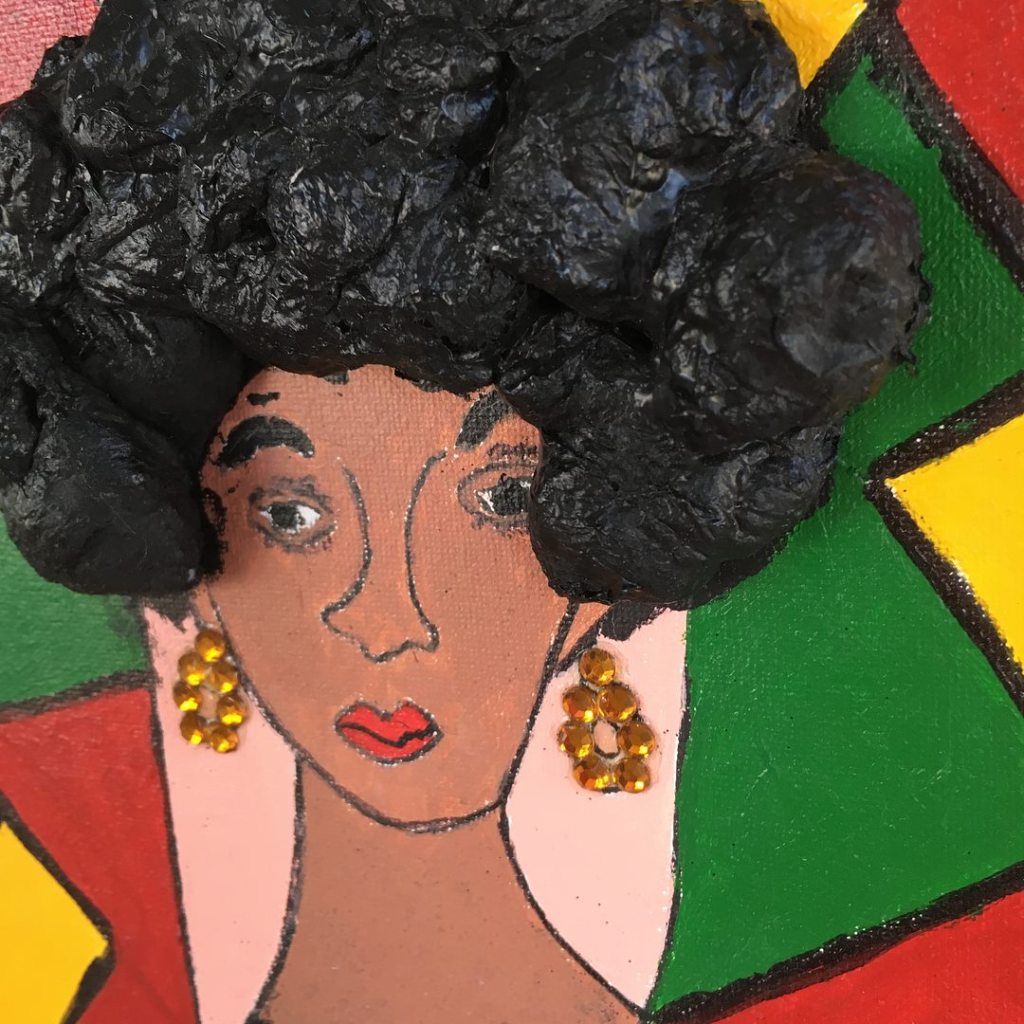
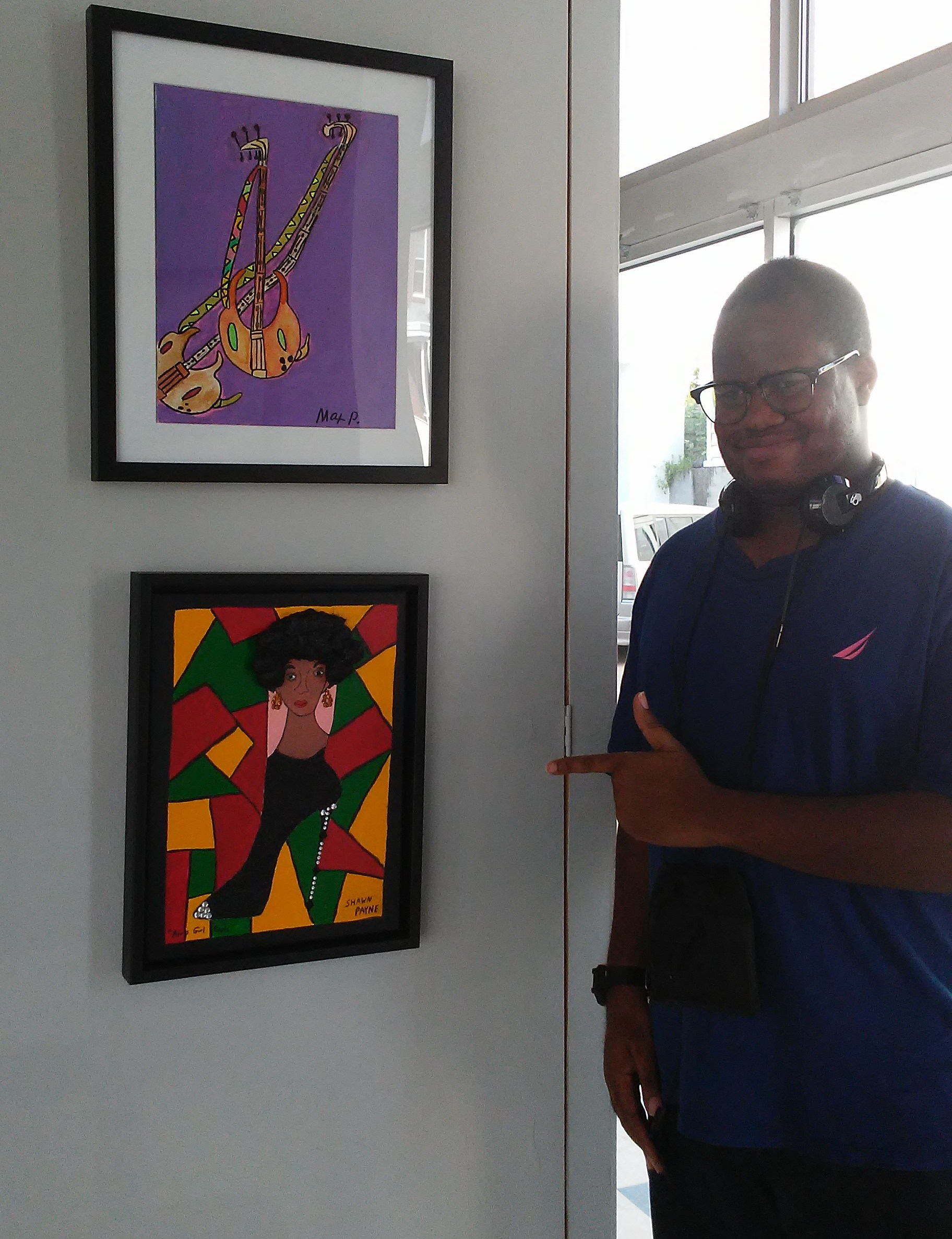
I really like Shawn Payne’s (from Art Enables) painting ‘Afro Girl Boots.’ I absolutely love his style of art, it has that 90’s vibe in it, and I love the traditional black, red, green, and yellow. Back in the days of the 90’s, black is beautiful is in the fashion industry, including cross colors clothing line. I like the dried black foam for her hair. I like a little bit of collage for the earrings and the details on the toes and heels. And finally, I like the acrylic background with famous African colors. I felt the 90’s theme in it and I can tell when I see it. It makes me miss the good ol’ days!
I enjoy places like Make Studio because you can be yourself and do your own thing with your art. No one is going to judge you. My best advice: Be You.
Tyrone’s own work can be seen in the core exhibition and in one of the Cordially Invited pop-ups (venue list available on our webpage soon).
Select works from other Make Studio artists will be on display, as well, complementing work by artists from the following studios:
Arundel Lodge, Inc.’s Open Eye Gallery (Anne Arundel County, MD) Art Enables (Washington, DC) Center For Creative Works (Wynnewood, PA) Creative Citizen Studios (Pittsburgh, PA) Creativity Explored (San Francisco, CA) Friendship Heart Gallery (Lancaster, PA) Gateway Arts (Brookline, MA) Pure Vision Arts (New York, NY) Starlight Studio and Art Gallery (Buffalo, NY) Studio In-Sight of Cornerstone Montgomery (Rockville, MD) Visionaries and Voices (Cincinnati, OH)
Artist Gary Schemes just returned from summer vacation with his family, and wanted to share highlights of his big adventure in “the most magical place on Earth”:
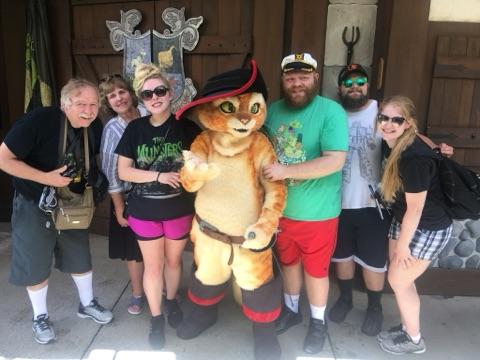
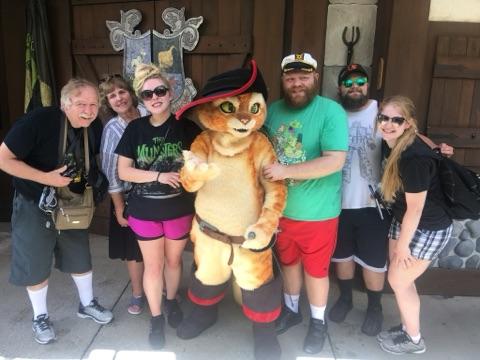
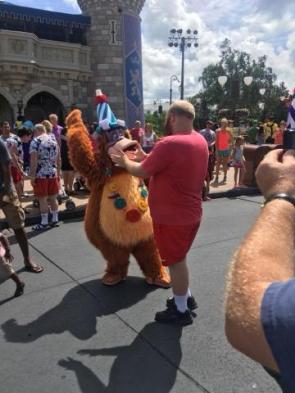
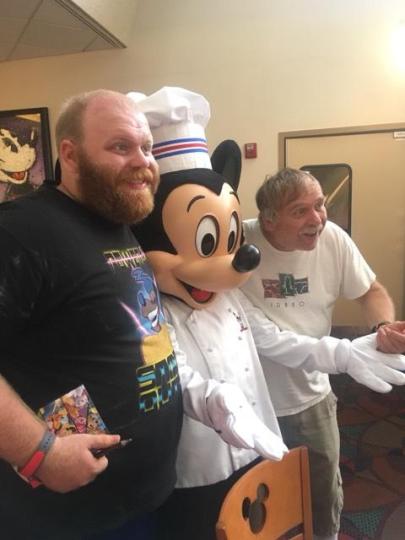
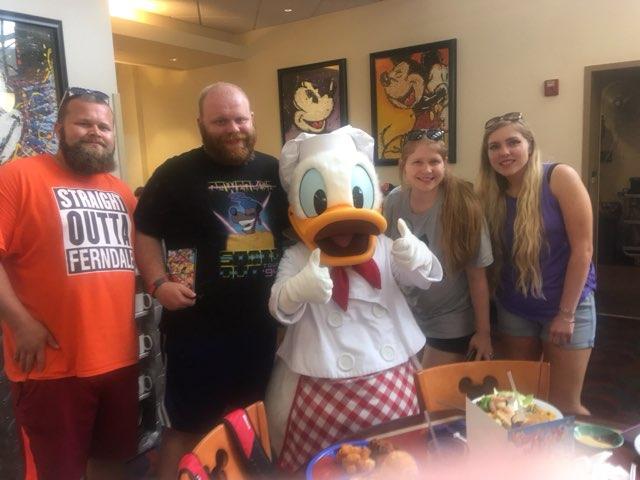
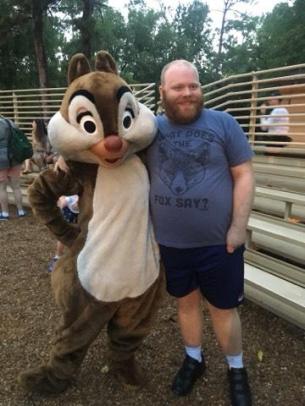
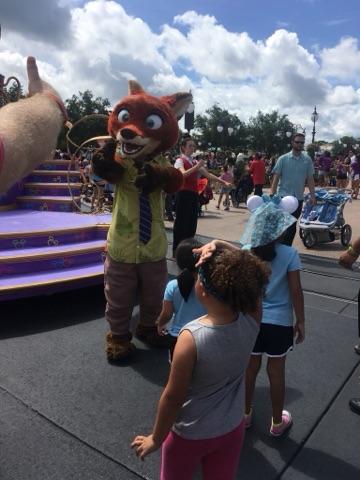
This was Gary’s seventh time visiting Disney World. (He’s been to Disney Land twice.) He got to meet many old and new Disney characters, gathering their autographs and posing for photos with them. He rode many rides, and ate some very delicious food.
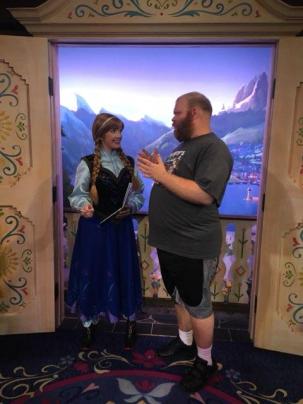
Despite having been to Disney world before, this trip was still full of firsts for Gary. It was the first time he ate breakfast at Beast Castle (from Beauty and the Beast), his first time at Chef Mickey’s Contemporary Resort, his first time meeting Olaf, and then, of course, riding the Frozen ride.
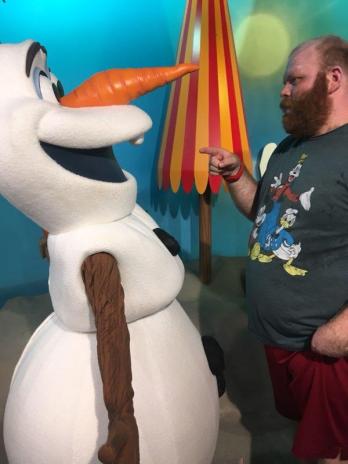
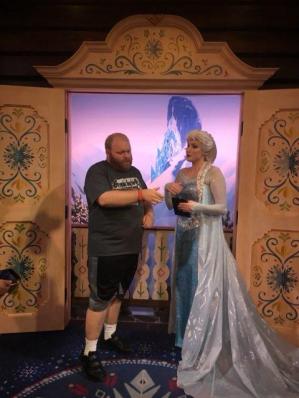
It was an especially big deal for Gary to meet Olaf, one of his favorite Disney characters! Then, he got to meet Anna and Elsa, also from Frozen.
“I poured my heart out to Olaf.”
“I told Elsa I drew a picture of her and asked if they are still popular to which they said ‘We think so.’”
Gary also had a fun meeting with Snow White. “I told Snow White, you are my favorite princess and without you there would be no other princesses!” Later, Merida, from Brave, told Gary she liked his beard because it reminded her of her dad’s beard.
When meeting Tiana from Princess and the Frog, Gary asked how it was to be a frog, to which she replied “slimy.”
Gary met Winnie the Pooh and Tiger together. He asked Tiger if he liked honey (Tiger said “no.”) Gary asked him to try to honey, but Tiger could not open the honey jar with his big paws! When saying goodbye to Tiger, Gary gave him a big hug and they bounced together.
Gary made many new memories from his week full of magic, wonder, and all things Disney!
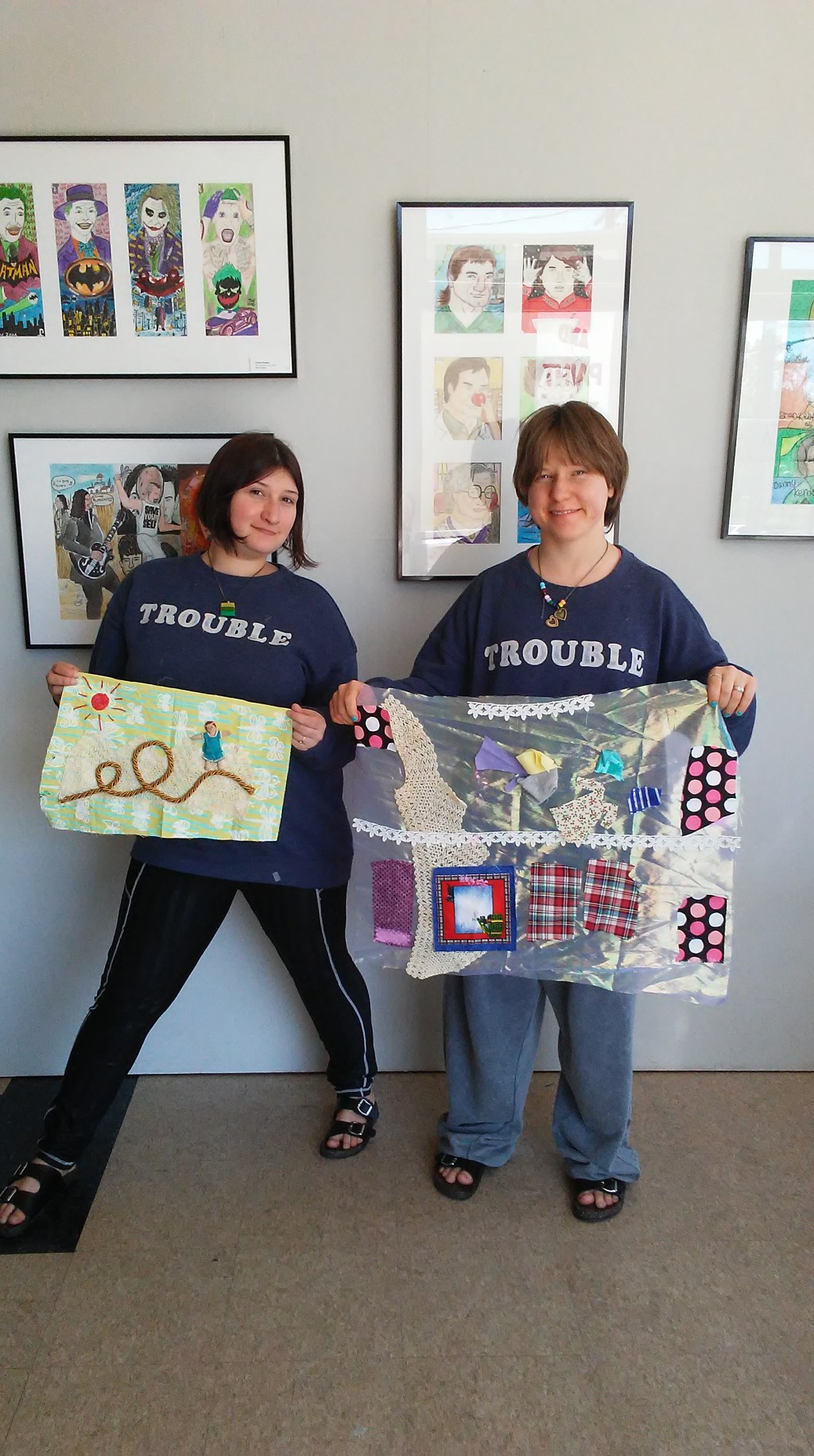
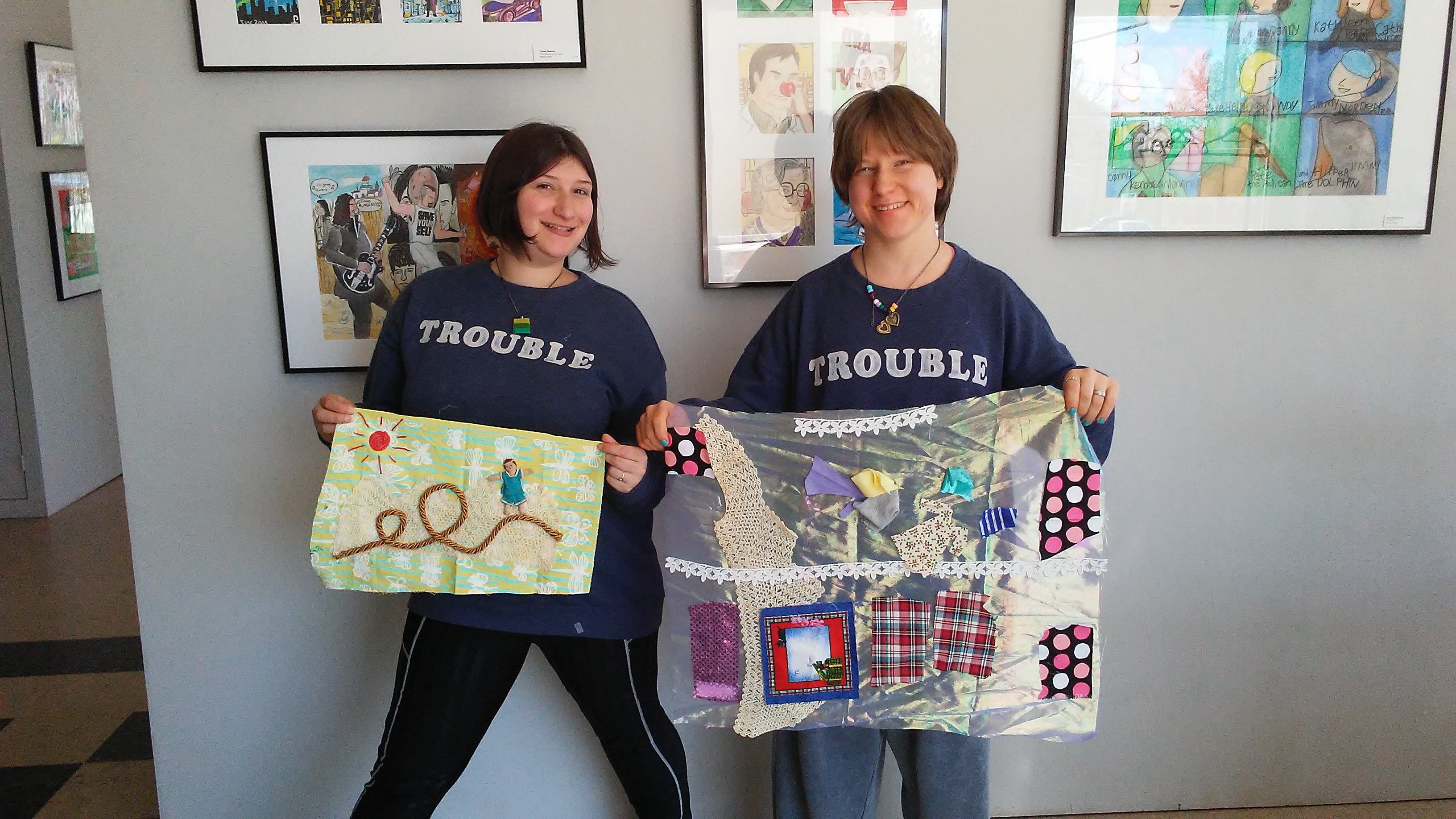
Artists Aimee and Dasha together led two workshops in one day last month, and they made sure their outfits matched for the occasion.
Here they share their experiences from that day, when they first demonstrated their techniques for painting on fabric at Hereford Library (as part of our “Being a Hero in Your Story” workshop series for our Inclusion in Art and Community exhibition), and then, here at our studio, co-led collaborative art-making with other Make Studio artists for students from JHU.
What as the best part about the Fabric Workshop at Hereford Library?
Dasha: I enjoyed all the people coming in and their curiosity about the project.
Aimee: It was awesome seeing how everyone felt about their work! And it was awesome to see people making their own art.
What was it like leading the workshop?
Dasha: I had fun teaching and showing off my art techniques!
Aimee: Same!
What did you learn during the workshop?
Aimee: There was a person working with fabric in a box and that was a new experience and learned from that.
Dasha: I learned how I could use yarn to hang up my piece and how thicker ribbon on the back held the fabric in place.
What did you make during the workshop?
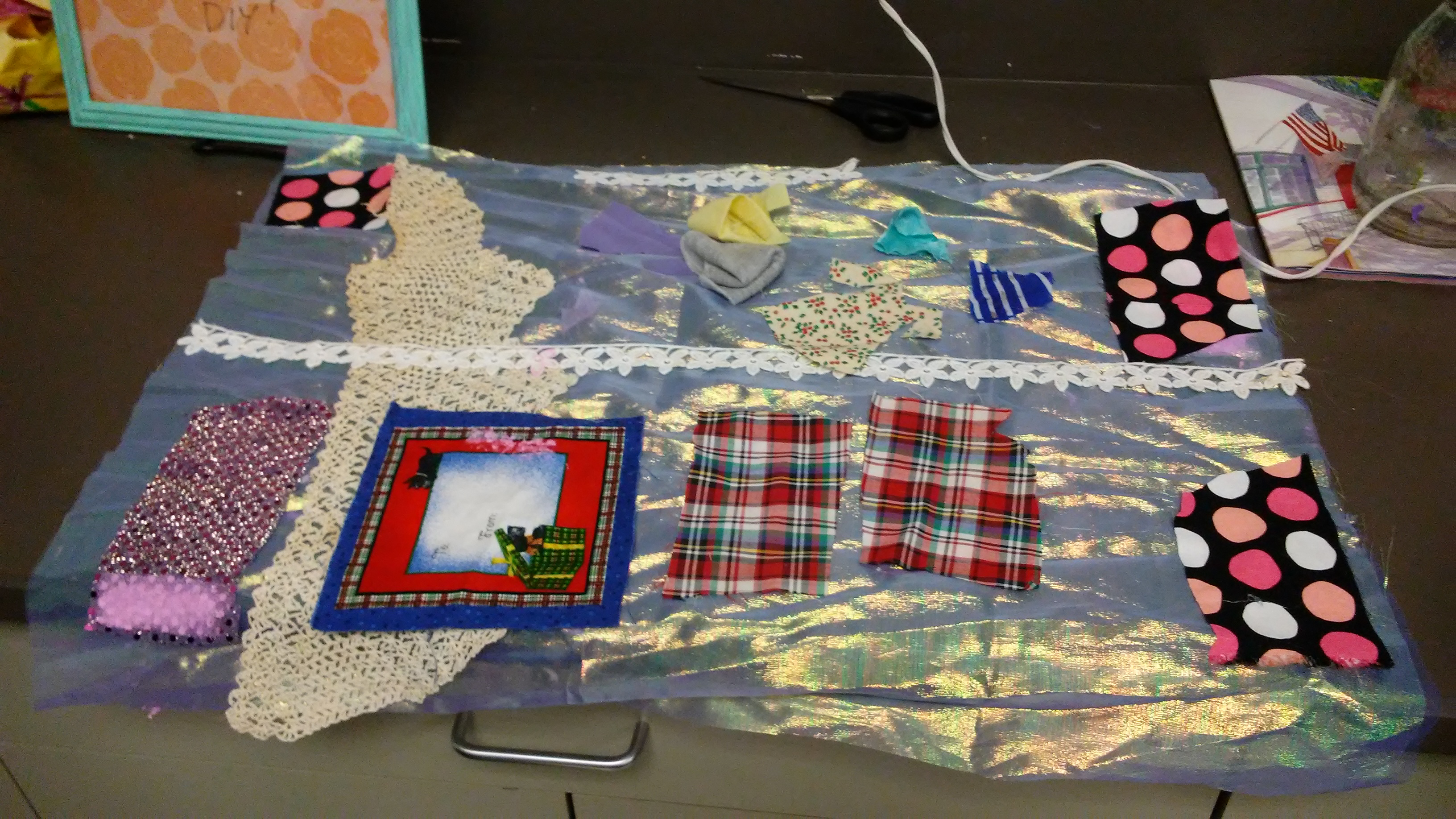
Dasha: I made a layout map of my bedroom. I used metallic fabric and glued down the fabric and folded the fabric to make the room look messy. I was thinking about the new wood floors going into my room so the art piece was a plan for my room with my new floor.
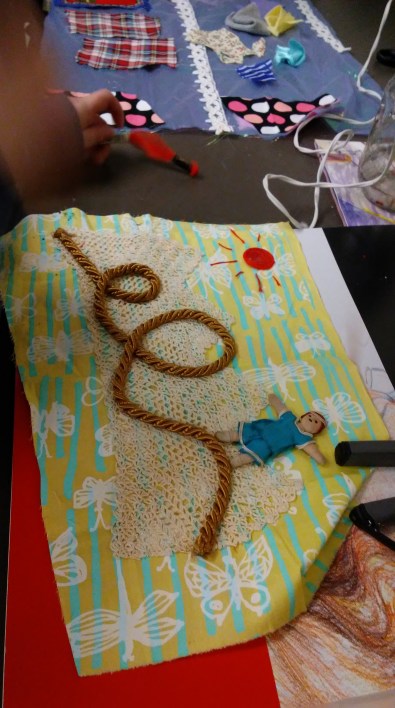
Aimee: I was remembering the ocean from a trip I took over the weekend. I found fabric that fit in with ocean colors, and used yarn and a small doll I found to pull it altogether.
What was the evening with JHU students like?
Dasha: It was good! I showed people how to sew on fabric and make a doll. I worked on a piece with Sabrina (a Make Studio intern who is also a JHU student).
Aimee: Good! I taught a person how to make Ka-Fancy (or a kitty doll). It was fun to see the Hopkin’s students working on their own projects.
Dasha: There were other Make Studio artists, lots of socializing and silliness. It was a collaborative experience. And we got pizza for dinner.
What was it like doing two workshops in one day?
Aimee: It was a lot of fun to do two workshops and there was more time to work on art.
Dasha: Some of the down time made me restless, but it was an overall positive experience.
Double Trouble’s parting thoughts:
We’re Double Trouble with fancy on the brain, creating the feel of our spirits going with the flow of fabric. Painting, sewing together, we’re growing! Art isn’t just what you see! It’s a magical adventure! Bold, subtle sometimes, our thoughts come together!
(This is the third and finalpost in a 3-part series, sharing highlights of my recent visit to China, on behalf of Make Studio and the National Committee on U.S.-China Relations (NCUSCR). You can read the first posthere. Thank you to Julia for several of the photos that appear in this series.)
In my previous post, I wrote about most of Shanghai activities with Zhu Xin’s/Julia’s organization World of Art Brut Culture (WABC). Here in this final installment of our “China series”, my goal is to wrap things up with how I shared the Make Studio message (i.e., our mission and how we and our artists put it to work) and how WABC staff and I started hatching some plans for the future.
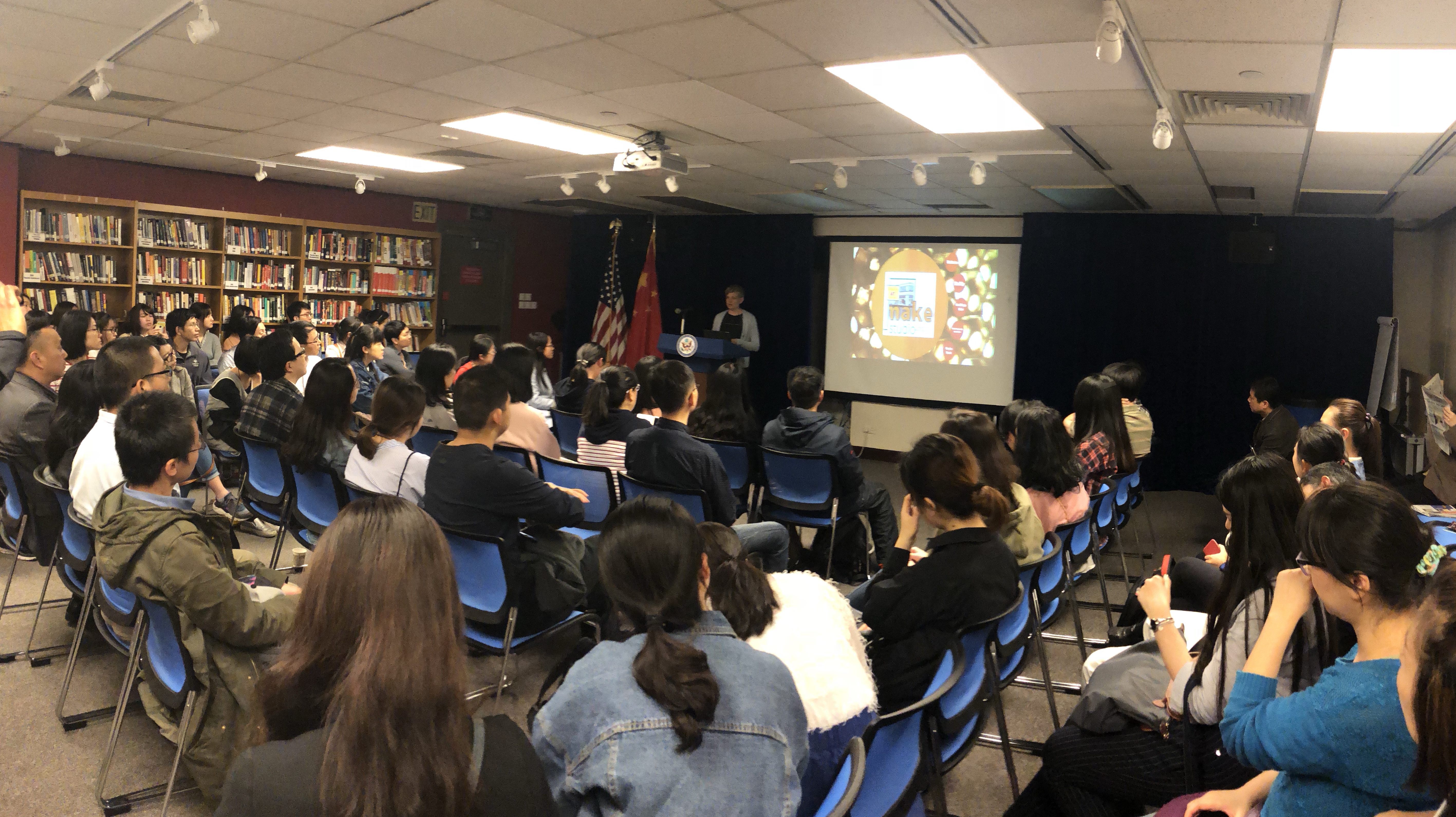
After I observed WABC studio activities and Rita’s art class one day, Julia and I went across town to the Shanghai American Center (ShAC), a program of the U.S. Consulate that hosts lectures, movies, presentations, and other programs on U.S. history, politics, society and culture. They invite U.S. and Chinese experts and academics in a variety of fields to share their experiences. As part of an evening dedicated to art therapy and related topics, on the occasion of World Health Day, I introduced Make Studio to a full room, following a presentation about clinical cross-cultural art therapy from fellow NCUSCR Fellow Ikuko Acosta. Art therapy and community arts are still relatively new concepts and fields to China, and the audience at ShAC was eager to hear from us and posed lots of interesting (and challenging) questions.
As our staff, interns, and volunteers always do when sharing Make Studio with new audiences, I emphasized that our artists are… well… ARTISTS. This audience was very receptive to learning more about what this approach to disability arts entails, how we set and maintain boundaries between “art therapy” and the vocationally-oriented work of our studio, and how we engage the wider community to further our goals of inclusion.
The next day was a busy and exciting one for WABC — one of their periodic “Open Days” when they open their doors to staff from NGOs, funders, and other interested community members. Open Days appear to provide a great avenue for WABC to share their mission, highlights of their recent activities, share contracting artists’ work, and to generate the fresh engagement and support that all nonprofits need. During this Open Day, the schedule included Rita’s and Dong’s demonstrations of techniques they use in their arts activities (audience participation required!), presentations by me on Make Studio and WABC’s co-founder and Art Director Huang Si on Outsider Art/Art Brut, and a screening of the Long Xu’s film.
This slideshow requires JavaScript.
Once again, I received fantastic questions about Make Studio, art therapy, and related topics from the audience at Open Day. In my presentation to them, I emphasized aspects of Make Studio’s model (and those of other progressive art centers) that are a bit different to WABC’s but could complement what they do. (WABC posted about Open Day on their own blog, for those who can read Mandarin.)
Less nerve-wracking for me than presenting to groups, but an equally important part of my trip, were the fascinating conversations that I had with Rita and Dong (touched on in my last post), Julia, and other WABC staff throughout my visit. In spite of language barriers, we exchanged a huge amount of information in a short period of time, and I hope they feel they learned as much as I did. I was particularly grateful that time was allotted for me to have long discussions with Beijing-based Jin Yanqing (Cynthia) and Gao Hua (Isabella) from the “WABC College team”, ably translated by Rita. We brainstormed and problem-solved about WABC’s programming, as well as their hopes to bring college-level training and more professional practices in art therapy to China.
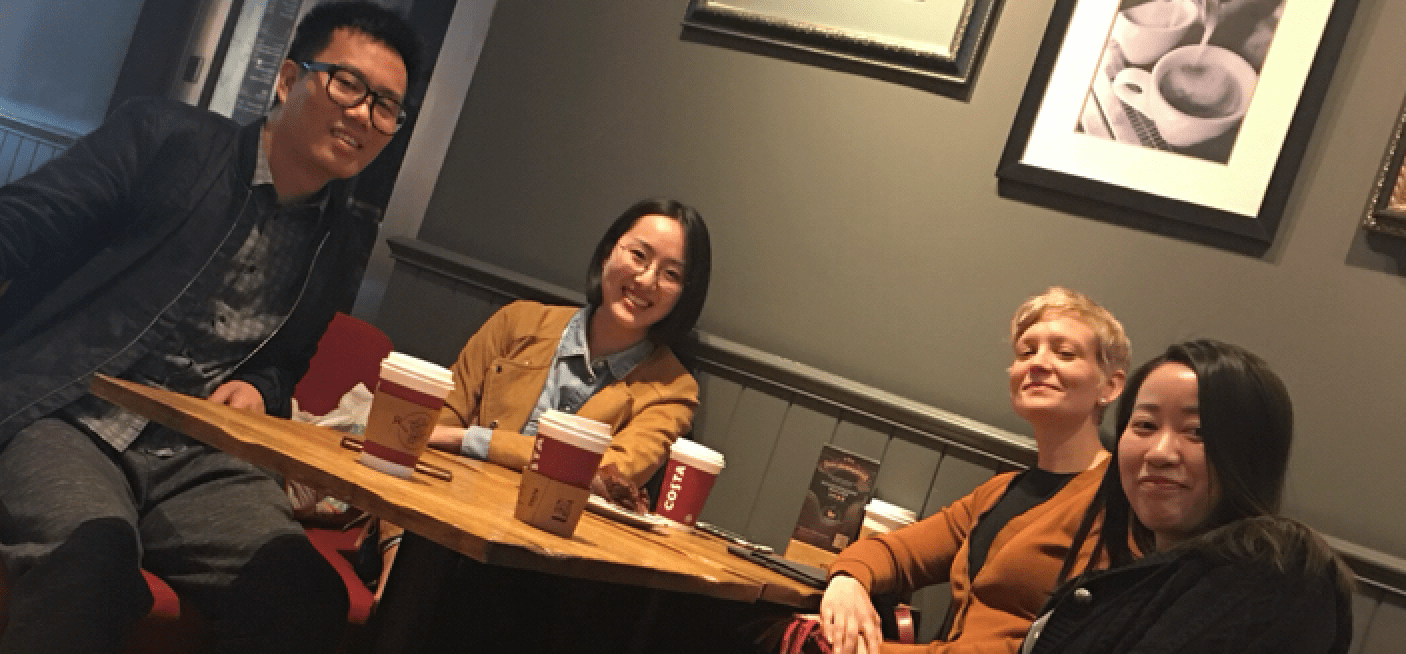
On my final full day in Shanghai, Julia, Huang Si, and Zhang Jie met with me over coffee to discuss how to foster broader and ongoing exchange and collaboration between WABC and American studios including Make Studio. Stay tuned for what comes next from this initial conversation!
Our productive early morning coffee meeting. (“Early” for both me and Julia is before 10 a.m.)
My time in China drew quickly to a close upon returning to Beijing the next morning, via a return train journey that was stream-lined from my earlier practice. I re-convened for two more days with some of the other NCUSCR fellows to trade stories about how tired we were and all that we’d seen as well as strategies for cramming souvenirs into our luggage, and did some essential last-minute site-seeing. (See a few more non-WABC specific travel pictures, below.)
This slideshow requires JavaScript.
Thank you everyone for coming along with me and Make Studio on this virtual journey, certainly a fave to be saved! We’re already beginning to follow up on all the knowledge gained and connections built with our new friends here, via NCUSCR, and in China.
Boundless thanks going out to National Commission on U.S.-China Relations, World of Art Brut Culture, and especially the smart, humble, and charming Zhu Xin!!
In my last post, I wrote about why I was in China and what my NCUSCR group’s orientation in Beijing entailed. In this installment, I’ll begin to talk about what I did in my next destination, Shanghai, especially how I spent my time with Zhu Xin’s/Julia’s organization World of Art Brut Culture (WABC).
After less than two days in Beijing, the NCUSCR U.S. Fellows each set out to the locations of their unique host organizations in different areas of China. Although WABC, founded in 2010 just like Make Studio, has 10 studios (!) throughout the country, my trip was focused on the Shanghai studio where Julia is based. So, unnecessarily large suitcase in-hand, I soon found myself on my own at one of Beijing’s dizzyingly busy train stations where there was a Dunkin’ Donuts amongst the station’s many food vendors, ensuring I had a familiar snack and caffeine for the 5-hour trip to Shanghai.
Upon arrival in Shanghai (population approx. 24 million), I was warmly greeted by WABC staff member Rita and her welcome sign with her drawing of me!
We got to know each other better — I loved learning about Rita’s artistic activities as a prolific cartoonist and illustrator and her aspirations to become an expressive therapist (!) — as she kindly assisted me in getting me to my hotel and in obtaining a local Chinese SIM card for my phone (an unforgettable experience not unlike being at our MVA, and resulting in my phone not working at all, but that is another story…).
Over the course of the next week, I would get to spend a lot more time with Rita, Julia, and other WABC staff, as well as doing a bit of exploring on my own in and around Shanghai.
Just a quick orientation to Shanghai. . . Shanghai prides itself on being uber modern and cosmopolitan and is widely considered to be China’s “capitalist showpiece”, reflected in the Shanghaieses’ embrace of smart phones, using QR codes for everything, and food delivery apps, as well as its constant traffic gridlocks and the glowing skyscrapers of its Pudong financial district (pictured below, clearly not my photo).
However, at the street level and across its diverse neighborhoods, day-to-day Shanghai still runs on traditional practices, small family businesses, scooter and bike based transport (of people and goods), and intergenerational relationships. This was very clear on my daily trips to and from WABC.
This slideshow requires JavaScript.
WABC itself is situated in a quiet oasis within the busy city, an office park of sorts created in a historical plaza to host NGOS, galleries, a civic museum, a few small businesses, and a children’s community garden.
Open space inside WAB’s plaza.
Event stage within the open space inside WAB’s plaza.
Community garden in WABC’s plaza.
Community garden in WABC’s plaza.
WABC-created mural outside of their studio.
The WABC studio itself feels like an oasis within an oasis, always colorful and fairly quiet even when humming with the activity of art classes or staff meetings.
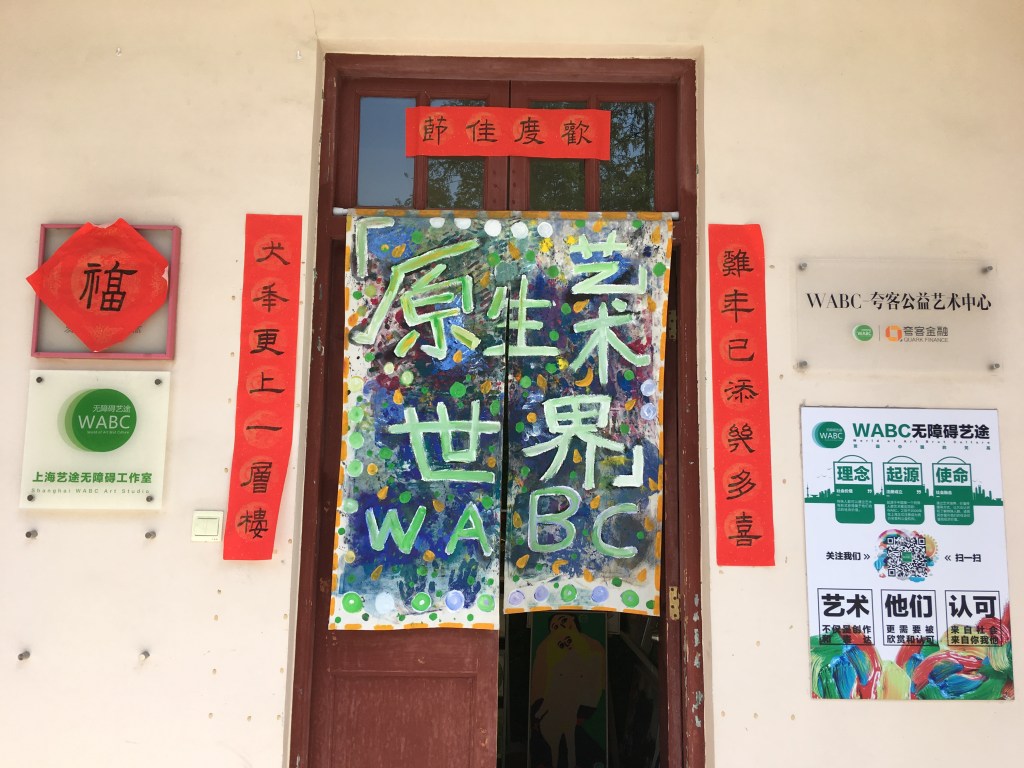
Front door of WABC.
Just inside the entry way.
This slideshow requires JavaScript.
On my first day with WABC, I was invited to sit in on a staff meeting (capturing the overall atmosphere, if not everything that was being discussed) and met WABC’s first artist, the very charming Long Xu, who is one of the few WABC artists that works in the studio in a way resembling Make Studio’s program artists (their program model is quite a bit different; many artists work at home or elsewhere in the community and contract with WABC). He and his mom, who works for WABC, are featured in this just released short film, “Unique As Everyone Else”.
Long Xu works in a variety of media but is currently interested in painting close ups of various animal eyes in oils, which he applies thickly with palette knife.
A recently completed frog’s eye by Long Xu.
An in-progress eye by Long Xu.
I then accompanied WABC’s artistic staff — Rita and Dong — to the weekly art classes that WABC is contracted to provide at a community “school” for adults with disabilities. Similar to day programs in the U.S., but structured like secondary settings that impart job skills training as well as academics, this is a service mode in China for people with disabilities until they are about 35. At that point, I was told, “graduates” often will stay at home with their families to help care for aging parents.
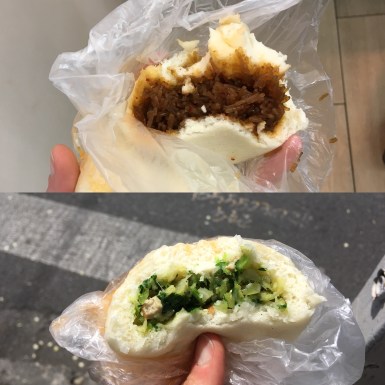
On the way to the school, Rita and Dong helped me to order a tasty and cheap on-the-go lunch of vegetarian baozi to bring on our metro ride across town.
Spicy mushroom and tofu and green veggies baozi, provided in a convenient sack for eating on-the-go.
Once there, I observed Rita and Dong lead separate groups in multimodal art activities — incorporating movement, dramatics, and drawing — that they’d each designed. (WABC provides training to instructors and volunteers, particularly about making activities accessible and inclusive, but the content of the classes I saw were driven by Rita’s and Dong’s planning.) The themes of both sessions were around social connection and appreciating others’ strengths. I was really impressed by these young instructors’ creativity and enthusiasm, as well as the talent of the participants! I could easily see that the sessions are eagerly anticipated every week — the participants met us outside as we arrived for hellos, hi-fives, and hugs.
This slideshow requires JavaScript.
Back at the studio later in the week, during a weekday class and a Saturday class, I was lucky to again be invited to observe and participate as Rita and Dong led adults with disabilities and volunteers in activities that WABC offers for free. (WABC also provides classes to children and youth.) These sessions, like those at the school, were also oriented towards connecting with others, but were more focused on exploring materials and aesthetic/sensory experiences.
This slideshow requires JavaScript.
Here I should add that Saturday classes at WABC often involve as many, or more, volunteers (folks in the green t-shirts) than participants from the community. This is indicative of the strong support that WABC has from volunteers, and perhaps more broadly reflects the growing interest in volunteerism in China especially among young people (who are not free to come on weekdays). Applying a Make Studio perspective, and seeing volunteers’ enjoyment and the deft way that Dong encouraged them to fully participate in the experience while ensuring that they didn’t try to “do for” community members, I encouraged WABC staff to consider expanding their offerings to fully inclusive workshops or classes.
Please stay tuned for the final leg of this series, Part 3, where I wrap this all up with how I shared the Make Studio message with different audiences in Shanghai and made plans for future exchanges.
Welcome sign for “WABC Open Day”, created by Rita. Find out what happened on April 12 in Part 3, coming soon.
Make Studio’s staff members don’t often contribute to this blog because it’s primarily a place for our artists to share their faves and reflections, but I’m making an exception (a small series of them). It seemed like the best way to share highlights of my recent visit to China, on behalf of Make Studio and the National Committee on U.S.-China Relations (NCUSCR), with our Make Studio family.
(This, the first post in a 3-part series, will be the wordiest one of the three. So please hang in there for parts 2 and 3, if fascinating photos are what you’re looking for!)
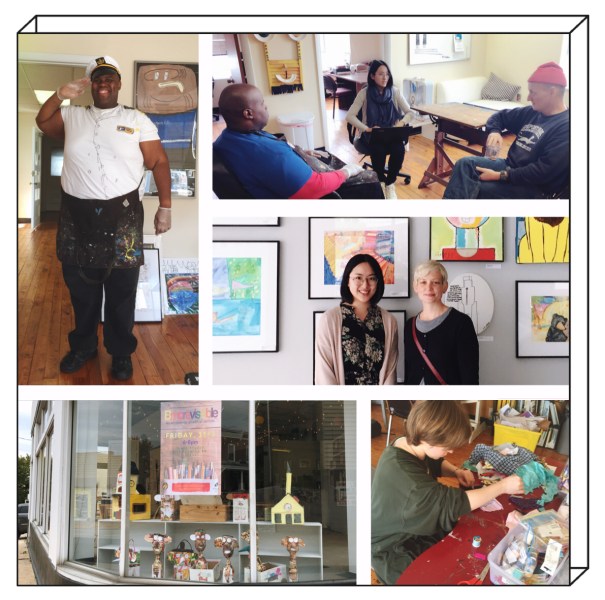
Photo collage of Julia’s time at Make Studio, provided by Julia.
U.S. host organizations can apply to NCUSCR to send a representative to China in a reciprocal exchange. We did, and we were honored that Make Studio was selected amongst several other, much larger organizations to participate. A few months and a lot of preparations later, and I found myself on the 13-hour flight to Beijing!
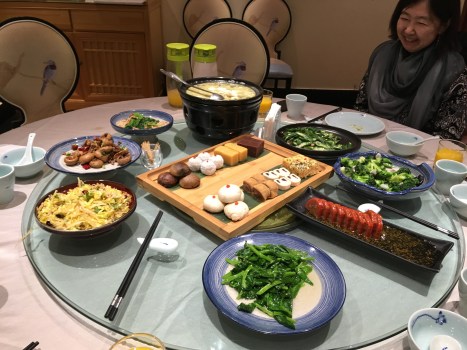
Once in Beijing, a group of the NCUSCR U.S. Fellows (excepting 2 who traveled on to Mongolia, and 1 who had to come later) received informal and formal orientations. We started with a crash course in avoiding oncoming traffic (cars, scooters, and bikes; pun intended), hailing local taxis, and “Peking-style” dining at a welcome dinner hosted for us by Irene Bao of the China Global Philanthropy Institute (CGPI).
Family-style dinner at a popular Beijing restaurant.
On our first full day in Beijing, we received an introduction to the current context for philanthropy, volunteerism, and NGOs/nonprofits in China, with a presentation from CGPI’s Vice President, Huang Haoming and a Q&A with their staff.
CGPI was founded by several philanthropists — five from China and two from the U.S. (Bill Gates and Ray Dali) — and is committed to building a knowledge system supporting the development of philanthropy for social good in China and throughout the world.
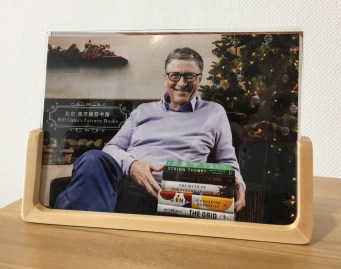
Spotted in the CGPI lobby: Bill Gate’s favorite books. Who knew?
We quickly learned that organizations in China face similar challenges to those in the U.S. — such as funding, volunteer engagement, and heavy workloads — but also deal with very different issues because “nonprofits” and “volunteerism”, as we think of them, are much newer concepts in China. There are also new laws that sharply constrain NGO’s activities.
Our understanding of these issues was then furthered by two on-site visits with staff at Beijing-based NGOs, arranged by CGPI. It turned out that I was the lucky one in our group, because both visits were highly relevant to Make Studio!
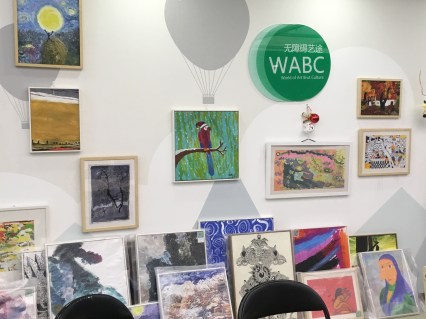
Artwork being prepped for exhibit at WABC Beijing.
The first site was WABC’s Beijing studio — giving me a sneak peek at program operations that I would later learn a lot more about at WABC’s Shanghai studio.
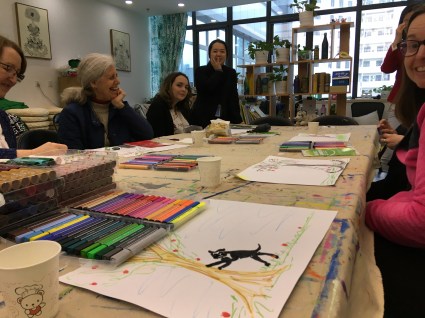
As a contrarian and an art therapist, I drew my dog “picking” an apple.
The whole group, however, enjoyed learning about WABC’s mission, their recent, massively successfully fundraising campaign, and experiencing an activity based on the Person Picking an Apple from a Tree (PPAT) assessment, quite familiar to American art therapists, led by a WABC art teacher.
After another decadent, traditional Beijing meal, we proceeded to our second site visit at Sany Foundation’s incubator hub. Towards their interest in “promoting scientific philanthropy”, similarly to a trending interest in non- and for profit incubation (with similar pros and cons that come with this concept), Sany Foundation incubates innovative projects in the interest of public welfare by providing them start-up funds, workspace, and other supports.
We were given a warm welcome and an informative introduction by Ying Li, Senior Program Director, in which she described how Sany’s incubator is a start-up itself and like a lot of young organizations it is working to firm up its mission, vision, and values. (These will have to remain a mystery for our non-Chinese readers and those who do not wish to take the time to translate.)
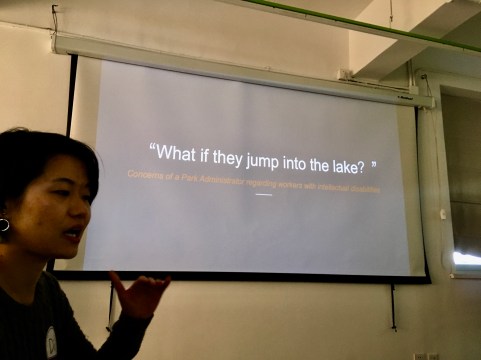
Next, the entire group was enthralled by the presentation given by Wu Di, Program Director and Co-Founder of Easy Inclusion, a social enterprise that provides disability inclusion trainings and strategies to companies to practice and benefit from inclusion.
Wu Di describes concerns of an uninformed administrator leery of hiring people with disabilities.
From Wu Di we learned about historical, problematic Chinese views on disability, which are not very different from ones we contend with in the U.S. But, also, how China’s policies regarding the employment of people with disabilities are radically different from the U.S.’s to both good and bad effect.
From both presentations, we all came away with a lot of food for thought about how policies shape our own programs, and how we can be more innovative in our approaches.
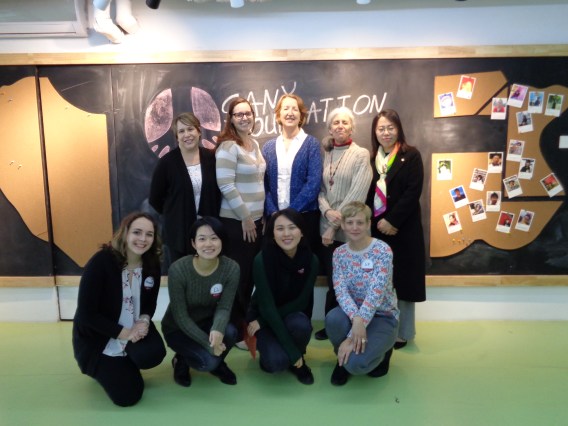
Pictured (l to r, starting top left): Heather McCann of Groundwork Lawrence, Jessica Ristich of St. Francis Community Services, Mary DeWitt-Dia of American Red Cross, Margot Landman of NCUSCR, CGPI host and intern (regrettably, names missing), Wu Di, Ying Li, and me.
Although our orientation in Beijing was brief, it provided me with loads of context to help me better understand what I’d go on to see and learn during the next leg of my trip in Shanghai.
Please stay tuned for Parts 2 and 3 of this series, coming soon, where I’ll share many images, and much fewer jet lagged words, from WABC Shanghai!












 faves saved